6,411 yards, 133 slope from the Blues
I remember going to a NCAA first round game years ago. Georgetown was a heavy favorite to go long in the tournament and their first round opponent was some college called Florida Gulf Coast. It was their first tournament bid while Georgetown is a storied college basketball powerhouse. The “aw shucks I’m just glad to be here” factor was high as the 15 seed against a 2, everyone was expecting a couple beers and a bag of peanuts while FGCU was the sacrificial lamb and Georgetown tuned up their lineup for the next few rounds. Of course, everyone was expecting that except the players on FGCU. They had other plans. Yet no one took them seriously as they opened up a lead against Georgetown, who was surely going to get going any moment and blow them away. FGCU led by two points at the half and that was fun and all, but Georgetown will come out swinging and end this cute uprising. Yet they didn’t. In fact, FGCU went on a 21-2 run, capped off by a thunderous alley oop dunk from the base line that definitively converted the crowd into thousands of FGCU fans instantaneously. They beat Georgetown by 10 points, then went on to the Sweet Sixteen. It was one of the more remarkable upset wins in sports history at the time.
Most everyone in that stadium walked in just hoping for an interesting game yet walked out witnesses of history. It happens, it’s why they play the games. Yet the reality is Gulf Coast was every bit as good as Georgetown all along. They just didn’t play the same schedule, were in a much different conference and were further devalued in the tournament seedings based on their first time there. On the other hand, Georgetown had the history, exposure, pedigree and conference so that it was much easier to seed them higher. Maybe Georgetown had their guard down a little just like the crowd expected more of a casual viewing of a blow out. Once the game started though, all those expectations, seedings, conferences and hype meant nothing. Expectation against reality is a powerful thing. But that’s why you play the games.
Knickerbocker and a few of the other courses reviewed recently are like FGCU. There are more well known courses out there, especially in the immediate area. It enjoys local fanfare for those who know yet it is unlikely anyone is traveling from the other side of the country to play the course. Yet when you filter out popularity and name recognition and rankings and the rest of it, there are courses like Knickerbocker that can certainly hang with the likes of the Georgetowns out there with just as much sophistication in design, challenge and structure of play. That’s why you play them all. Invite yourself to consider your own rankings could have some upsets against the perennials. Consider that yes, some of these lesser knowns could also be great golf courses themselves. Then consider the possibility of that rankings list changing by the day. Then consider disregarding it completely. Yes, there are a lot of rankings list here on this site but I always feel like the Comic Book Guy from the Simpsons anyone asks me what my favorite course is. “Favorite as in best design, or as in where I would want to play day in and day out, or where I would play my last round ever, or the one I would want to be imprisoned within, yada yada yada.” It’s all relative and within that, there may be times a course comes along and you seriously think it’s comparable to one of the heavy hitters. Don’t worry about the shock value of that and instead, think about why you’re of that opinion. That’s one of the sweet spots of interest when it comes to the study and discussion of golf course design.
Knickerbocker is certainly worth playing for a number of reasons, including its architectural merit. It may not have measured up to some of my more notable favorites but enjoys this isolated pocket of distinction with respect to courses with Donald Ross pedigree. In fact, it is rather tough for one to find a more eclectic Donald Ross design than the likes of Knickerbocker. The first nine holes opened in 1915 and the second the following year. Herbert Strong then designed a third nine holes that opened in 1928. Strong’s work was then combined at holes 2 – 9 as well as 13 and 14. So in all fairness, some of the current layout is derived from Strong’s work, yet Forse and Nagle underwent restoration work in 2008 that focused on adding Ross character. Of course, Jaeger Kovich is now involved in restoration work that will focus on emphasizing the design character of both Ross and Strong. This all adds to the eclecticity. And yes, I just made up a word. The routing and how it transitions is what sticks out here. The starting sequence is of the warm handshake variety but then things slowly shift to rambunctiousness, the crescendo at the Sixth with its extraordinary slanted green rising out of general flatness. The closing trio on the front transitions once again. While the golfer might have just become accustomed to the challenge being mostly at the wild greens, things now become much more about placement accuracy. This then transitions early on the back where the scale expands once again, yet brings with it the wild contours we saw towards the close of the front. The rest of the back fluctuates in width from shot to shot and green to green. It’s a wild ride where the terrain is used a variety of ways, thereby a constant change to the structure of play is before the golfer like a Rubik’s Cube. Alas, my thoughts on the course kept changing even during the round. All the better. Like the crowd at that FGCU-Georgetown game that went from casually checking in to actively buying Gulf Coast jerseys during the second half, I walked off the Eighteenth here a convert.
The First is a 380 yard par 4. A narrow fairway meanders between the tree line on the left and trees on the right. A bunker on the left well ahead defines the fairway and creates a choke point just before the green. Things widen after that point and the green is on the larger side but with movement towards the edges, one does need to exercise a good deal of caution with speed control.


The Second is a 518 yard par 5. A longer hole slightly bending to the left with yet another rigid tree line on that side. Bunkers are interspersed on the right as you move towards the green while the ideal approach angle is on the left. The safer right side cuts off the amount of roll out room one has at the green. With everything mostly on a gradual downhill, speed control is paramount in avoiding the sunken bunkers.


The Third is a 414 yard par 4. Still riding the perimeter of the property with that tree line on our left, the tee shot dog legs around the trees to the left. There is some give off to the right for those not willing or able to get the ball to turn left off the tee but some how managing the turn is needed to end up in the fairway. A bunker at the right center is ideally placed to collect tee shots that don’t turn enough and is reason to consider a lesser club off the tee. The fairway narrows considerably after this bunker, straight down to the green yet there is water on the right for those that stray. A slight uphill helps control the approach a bit more and the green is on the larger side.


The Fourth is a 145 yard par 3. More or less a forced carry to the green although there is a strip of fairway leading to the green on the left side. There is a long apron before the green and then the green expands towards the water with bunkers surrounding it and water to the right. The tee shot is rather straightforward but the green movement was much more interesting.


The Fifth is a 343 yard par 4. We finally move from the perimeter to the interior. Trees and bunkers are on either side but the fairway is wide as the green is uphill. Branched out bunkers guard the green at the lower front while the green sits at the top of the the hill and falls off at its outer edge. The approach will likely be blind but it is paramount to clear the hill and bunkers or else the golfer will likely face a blind recovery.


The Sixth is a 168 yard par 3. The course now grabbed my attention. A par 3 on relatively benign terrain with the boldest contoured green on the property. The left side is pulled up and in so that it seems to be arching over the rest of the green. The brings another dimension to the round dealing with such a wild contour where by the way, missing left becomes the dead zone. Perfect placement within the round.


The Seventh is a 421 yard par 4. We can’t get away from the left tree lines even when we’re in the middle of the property. Here we head straight out then uphill to the green. The tee shot is free of any trouble, which is all much closer to the green for an approach that will turn out to be longer than the golfer expects. The green at the top of the hole runs quick and with the longer shot in, roll out must be expected.


The Eighth is a 383 yard par 4. A blind tee shot that moves downhill, so those who are able to reach it will see some propelling towards the green for a shorter approach. The green is on the smaller side with bunkers on the left and right. There is a good amount of run up to the green that should be used for the approach unless the golfer can stop his shots abruptly.


The Ninth is a 339 yard par 4. A dog leg right through the trees as accuracy becomes more and more valuable. The tee shot must manage the trees and turn of the fairway, as well as the bunker on the left that is in smart position. The green is deep and narrow with the rear its widest, bunkers lurking below on either side. Once again, an accurate approach is all that will do well here.


The front nine starts off nicely but its structure of play transitions in series, reserving the more demanding for the closing. The variety of positioning, size and movement of greens sets up the rest of the holes. I would rank them 6, 8, 7, 2, 3, 5, 9, 1, 4.
The back nine starts with the 486 yard par 5 Tenth. The tee shot is straightforward enough moving a little uphill. There’s a large bunker on the left and then it’s tough to make out the rest of the hole. This is because the fairway drops downwards, a hillside of rough moving down to a brief second fairway before an apron to the green. The green is on the small side and surrounded by mounds with bunkers on the sides. It is well protected for those aiming to go for the green on their second shot, yet some may be fine with that risk since the recovery should be tolerable save for ending up in the hillside of rough before the green. The front starts much different from the back and the course transitions yet again.


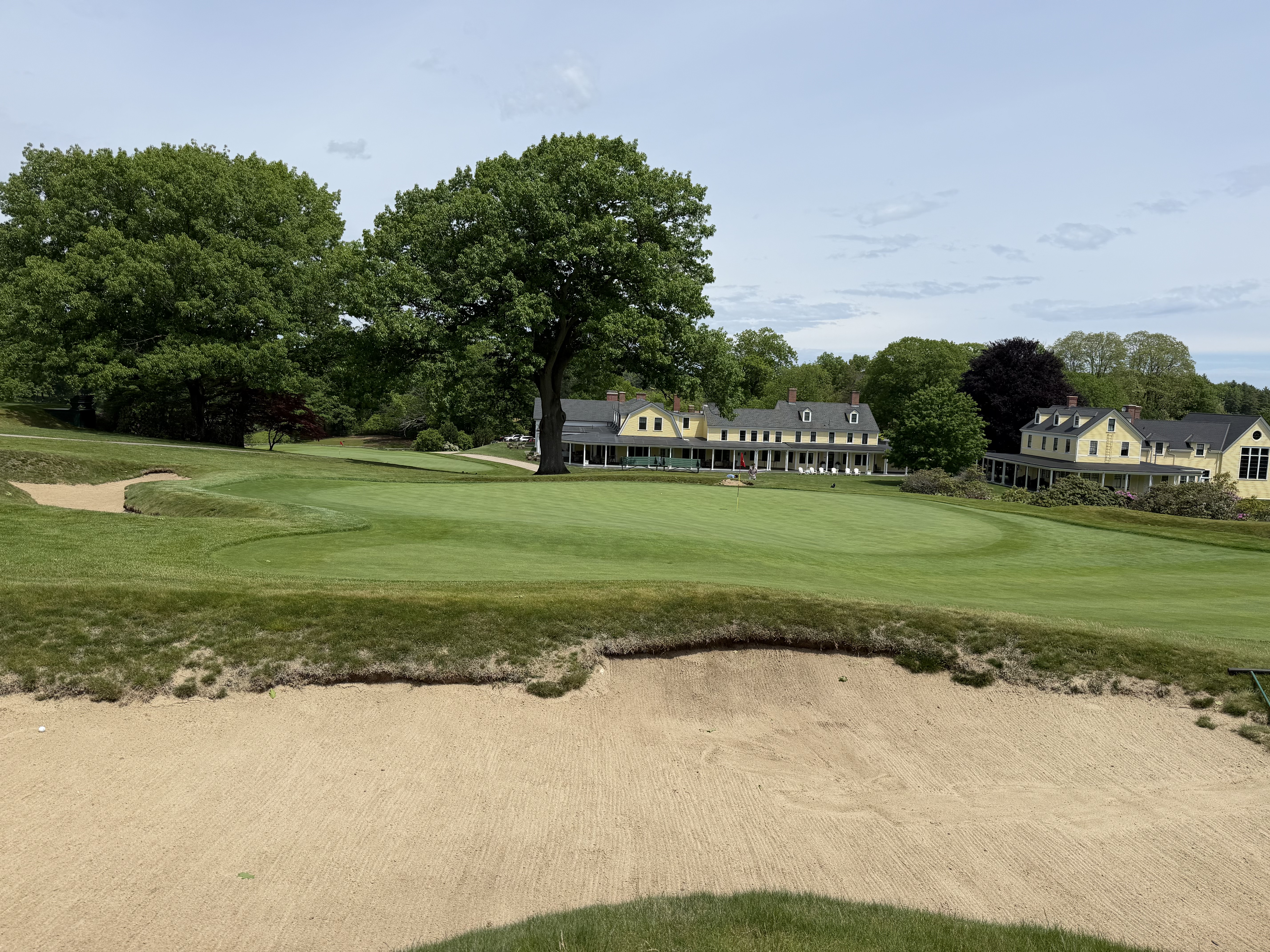
The Eleventh is a 156 yard par 3. An elevated green placed on the hillside we just cross over on the hole prior, it is settled into the ridge rather comfortably with a few well placed bunkers about. The green is rather large with the center at its widest with many of the bolder contours towards the edges. It’s a good par 3 where hitting the green is only half the story.


The Twelfth is a 421 yard par 4. Yet another tree line on the left and this one has a ditch running along that side for good measure. There are no bunkers to speak of and there is considerable width, all the better since hitting the fairway is rather imperative. The approach must carry a creek and then deal with the green, which sidles up to water that is on the left. The entry point to the green is shifted to the right and reaching the center of the green means carrying a bit of the water unless the approach comes in from the right, in which case it needs to mind its speed upon landing so it doesn’t run into the water. It’s a tough approach, yet there is lots of room to lay up if the golfer wants to rely on his wedges to get close to the pin.


The Thirteenth is a 525 yard par 5. A double dog leg through the trees that initially turns right, then left to the green. Maneuvering up to the green with the turns and bunkers at the turns, the widening and tree work have helped bring an array of decisions and options in this regard. The green is raised and surrounded by bunkers and kind of dog legs itself to the left. Not really forgiving horizontally but if you feel the need to go sideways, make sure it’s to the right since left is as dead as Zed.


The Fourteenth is a 379 yard par 4. This hole is now different as the tree line on the left has been spaced out considerably. Good call because it was a bit of a head scratcher before. The concept is that there is a narrowing of the fairway where the golfer must decide to either chance his driver or lay up short of. The problem is with trees, the golfer must also keep his shot dead straight and even then, the trees block a lot of approaches. The left side now has a bunker complex and with less trees on that side, accomplishes the purpose of a choke point while allowing the golfer more strategy in playing the hole. The green is surrounded by bunkering around the rear yet is left open at the front and is rather deep. The entry point is set to the right a little so favoring that side off the tee could be advantageous.


The Fifteenth is a 341 yard par 4. Heading back uphill, the trees start to yield and a dance between scales starts to take shape. There’s a bunker at the front right that the fairway moves towards. Approaching the green by carrying it is an ideal angle to take advantage of the back to front movement.


The Sixteenth is a 302 yard par 4. The last few holes have bordered on shorter par 4’s but now we’re presented with a short beyond all reasonable doubt. The hole turns left from the tee and as we are now aware by routine, left is no good at all. Bunkers line the fairway on both sides all the way up to the green. The turn and bunkers from the tee are enough for sensibility to take over and temper the tee shot to the fairway we can see. But no, most of us will wail away and try to get as close to the green as possible, at our peril. Most won’t be able to turn the ball over and will end up off in the right bunkers or beyond, some will overcook and end up out of bounds off to the left, others will end up in a bunker well short of the green and need to deal with that while some may find themselves over the back of the green with a difficult recovery back to the green. History repeats itself and this short par 4 is set up to welcome temptation then make us pay for succumbing to it.


The Seventeenth is a 207 yard par 3. Ross had a proclivity for the raised volcano green and this one reminded me a bit of the one at Bedford Springs yet this one is not as uphill. Probably the biggest scaled hole on the course, the green is of an enormous surface level yet those missing it will need to heave their next shot into the skies to reach it. Like the hole prior, long is no good here.


The Eighteenth is a 482 yard par 5. A shorter par 5 dog leg left that moves up, then down to the green. Hardwoods frame the turn, which puts pressure on the tee shot and makes it imperative to get back in position if one starts off poorly. After the turn at the downhill, the trees clear and the fairway lists left to the green. The green is insulated with sunken bunkers around it save for the front entry point. It’s an opportunity to close the round with a nice score and ending things on the right note, bolstering the golfer’s hopes and dreams for that next round, where he is sure he will finally get all the breaks.


The back nine builds on the excitement and thrills we saw glimpses of at the front as the middle shorter par 4’s transition the structure of play nicely. The par 3’s were very good as well. I would rank them 17, 11, 10, 12, 13, 16, 18, 15, 14.
Generally, Knickerbocker does a great job varying play while avoiding too much boldness or quirk. It starts with the variety of the greens, then how the fairways rely on the terrain and make their way to the greens in conjunction with the hardwoods. The structure of play favors shotmaking but does not demand it yet those plagued with a hook will have a very long day, as the left side is constantly blocked out with the counter clockwise routing. All of this instills a sporty nature to the place. I believe the recent work will help improve its recovery character yet otherwise, it’s a classic design that offers every inch of challenge and thought as its contemporaries.
Clubhouse/Pro Shop: The clubhouse is on the side of the road with the driving range, short game area, pool and courts while the pro shop is on the other side with the course. I enjoy that separation and as a member, you would find me in one of the chairs in front of the pro shop more often than the clubhouse or pool.

Practice area: Driving range and short game area on the clubhouse side while putting green is just outside the pro shop next to the First tee.




You must be logged in to post a comment.