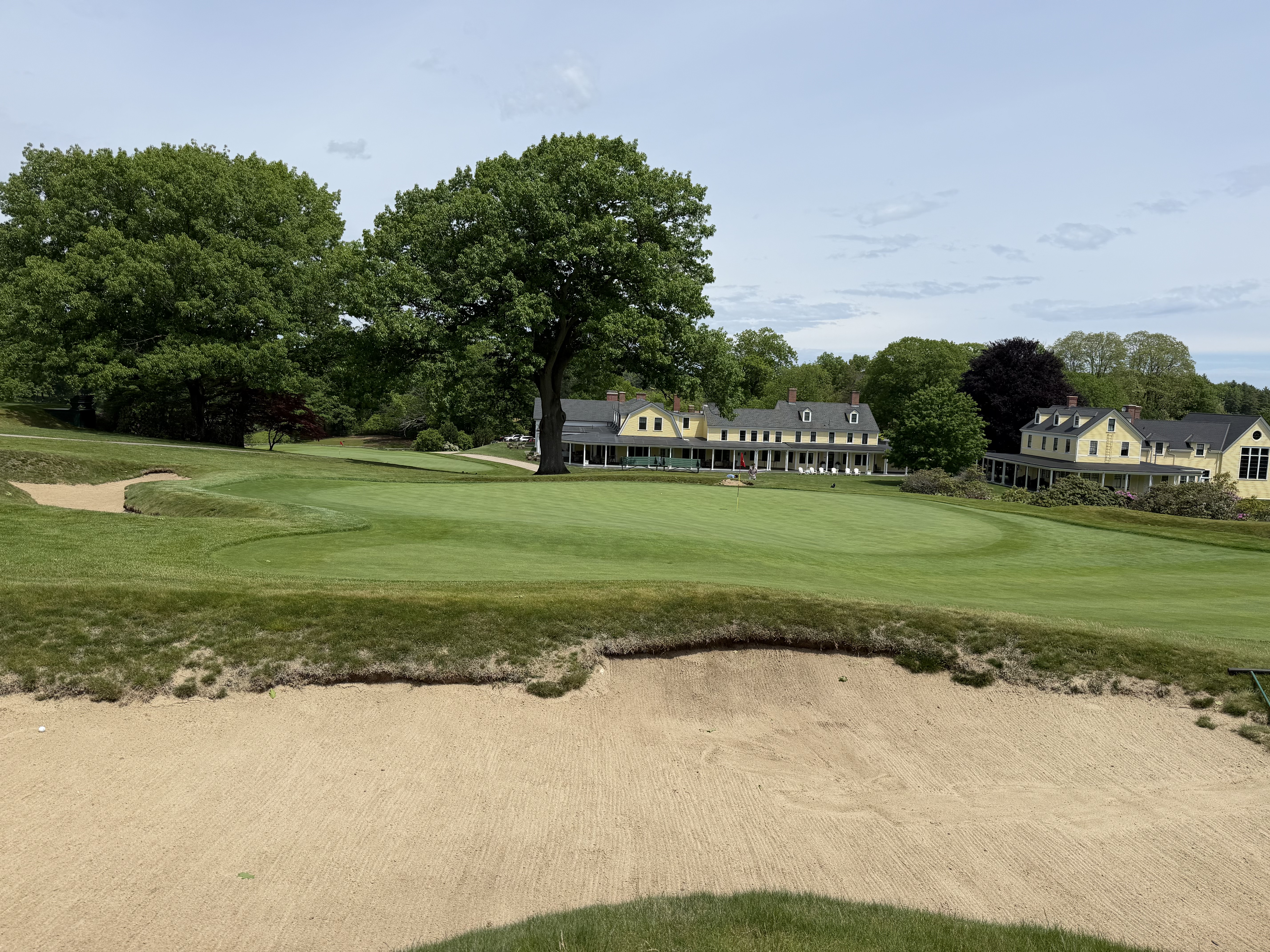
As my putt fell in the hole at the Eighteenth my first time here, there was a strong desire to go right back to the First and do it all over again. Not for the views or saddling up to the beach or just being in one of the more beautiful places one can find themselves, but for the sheer purpose of getting to know the course and indeed play it, better. I didn’t do the approach at the Sixth justice, I duck hooked my tee shot at the Tenth, I completely butchered the Eighteenth with choppy strokes. It wasn’t all bad with my couple birdies but still, for whatever reason I equate paying homage to a course I deeply appreciate by playing it well. It’s some irrational idiosyncrasy but so be it, likely something to do with being able to see the course at its full potential. But really, it had most to do with my fascination with the design. There’s a smoothed over, polished calm that prevails over the course so that even the template holes seem to appear in an inevitable natural progression.
So it was I found myself back for another round the very next season. Indeed, the brief amount of time between rounds is a Redux first but obviously essential. I arrived back at the Creek like a decades old member. Yes, parking is over there, yes, the bag drop is right around this way. And oh yes, the locker room is back here. It would be a much more leisurely time on the grounds this time around. Lunch before the round, warming up at the range, a little hang out time afterwards. My game was in much better shape and the weather was shaping up to be perfect. And with a resounding yes, it turned out to be a perfect round.
The initial course review is fairly comprehensive of its design evolution but it bears repeating that the Creek was one of Macdonald’s later designs, constructed by Raynor. William Flynn thereafter instituted some significant and beneficial changes, including the sandy waste expanses found on the lower portion of the property at the Ninth and early holes of the back nine. The polish of the course blends in with the naturalism of the waste areas and water while the greens exude strategic command all the way back to their tees. Gil Hanse began consulting here in the late 1990’s, imparting restorative components as needed since then. The end result is a brilliant, refined design placed upon some of the most sought after, visually pleasing grounds one can find.
My first round here, the following really grabbed my attention.
- The First struck me as one of the better opening holes I had come across;
- The ensuing early parkland holes were well presented, making for a higher level of strategic golf;
- The Sixth green was incredibly individual;
- The Reverse Redan was the best I had seen,
- The sandy waste areas were a brilliant component; signifying a transition from the structured strategy of the parkland holes to a more laissez faire navigation among sand, wind and water;
- The Tenth is one of the better designed short par 4’s that takes advantage of the natural surroundings perfectly; and
- The climb back up the hill once again transitions seamlessly, the golfer returned to the polished sheen of the parkland contours.
So really, it was the routing among the sandy coastal hill and dance between low lying natural links and formal parkland hardwood, all of it at a higher degree of refinement. This versatility is what ranks it so high for me. Ideal yet varied use of the terrain.
The Redux round reaffirmed and/or impressed the most.
- The First is even better than I remembered, as is the Second, making for one of the better opening duos I can think of;
- Why didn’t I remember the Fifth green better? The deception of that approach is so playfully scandalous;
- I hit the approach I had been pining for and it was as glorious as I had hoped as the ball started on the left and dramatically sashayed to the other side of the green;
- The Seventh is just as much of a transition hole as it is a respite. It allows the golfer some freedom to get his swing in order before taking on a tough stretch that really doesn’t let up until the Short;
- The sandy expanse also allows the course flexibility in the wind, which frequents that area;
- The contrast of the sandy low profile holes against the parkland holes stood out even more. Roughly, I’d characterize the parkland holes as 1 – 6 and 15 – 18 and the low profile as 8 – 15 (tee). The Seventh enjoys a hybrid of both, straddling the hill and indeed connecting the upper parkland with the lower links; and
- The greens are some how even more subtle than I remembered.
The setting is ethereal but how the design incorporates the setting is even more impressive to me. Views and scenery are also a pleasant component to any golf round but if and how they influence the structure of play is what can elevate a course from good to great. Similarly, the character of the terrain dictating the personality of a golf course is going to be explored in more detail in the coming weeks but for now, allowing personality to flow from the natural environs has always been a hallmark of greatness. Here, Macdonald certainly cultivated that trait while delicately transitioning when appropriate. This is where course architecture thrives and gives us that remarkable, lovely relationship the golfer enjoys with nature. Metaphysically, it enhances what draws us to the wilderness in the first place. There is no better example of this than at the Creek.
When the ball dropped at the Eighteenth this time, I was more fulfilled than anything. And appreciative for that window of opportunity to glance in and have one of those days of golf where all that will be remembered looking back, even years later, is undeniable bliss.




You must be logged in to post a comment.