6,578 yards, 138 slope from the Blues
Different ways to go about the same thing. What comes immediately to mind are surfing and skiing. In surfing, there is the long board and short board. The long board is a more cruising style of surfing where the board sails along at its leisure. The rides are usually long and get as fast or slow as desired. The short board is a more thrashing and carving ride where the surfer moves up and down the face of the wave relentlessly, trying to cover as much of the wave as possible in the shortest amount of time. Both are surfing yet quite different. I was always a longboard guy. Then there’s skiing and snowboarding. They’re more similar since both can get pretty versatile on the mountain, moving from long lazy turns to some carves and anything in between. Skiing can be quicker and snappier, especially around moguls. Even though the styles can get similar, they contrast more in a big picture kind of way.
Surfing and skiing were my introduction to an engaging enjoyment of the outdoors. They’re a meditative experience where the rest of the world seems to cease existing. All that matters is the nature and the wave, or mountain, as it were. You eventually unify with that force and start to understand, feel, anticipate it. Some are fine getting to that place while others keep exploring and pushing the threshold of comfort. Bigger waves, steeper runs, faster, higher jumps. It’s a way of pushing yourself, trying to figure out if there’s a limit. There always is; it’s just a matter of when and how we find out.
The first time I surfed was in college. I had no idea what I was doing but pretended I did for whatever reason. We went to a break and there were a group of dolphins not far from the shore swimming around. This isolated beach, which we needed to walk along this path of wildflowers to get to that opened up revealing the ocean and those dolphins, stays with me to this day. That preview of the natural habitat I was about to literally plunge into was both exciting and anxiety-ridden. We decided on a break further down where the waves were better formed. The waves were middle of the road but they felt enormous to me. I had a tough time even paddling out and then when I did get a wave, I couldn’t stand up or stop for that matter. I promptly crashed my board into an inlay of rocks at shore and that was it for the day. Yet I was hooked. Being in the ocean, the ruthless crashing of the waves that quieted most everything else, the gentle quiet between sets; I was in. It was living and as the highs and lows of college came and went, surfing was always the constant that life is a gift. It became a big part of my life until I moved out to the east coast.
Skiing was different because I grew up with it. It became second nature and it wasn’t long before I started to push the envelope. I wanted to go on the most difficult runs, off cliff points and be the fastest. The speed never bothered me. I just learned to stay relaxed, as that allowed me to react when I needed to and maintain balance to handle whatever came along. I started picking up on the feel of the snow and air to figure out how the mountain was running that day. The exhilaration of gliding down those slopes as you’re screaming past everyone and everything with the dramatic views well below almost remaining still in the face of your plunging at those heights above. The world takes on different meaning. It would have been nice to stay in that zone and pursue it even more but those days have come and gone. It’s something I continue to enjoy, even as I catch myself every now and then looking for the lines of that envelope.
Both spiritual pursuits in a sense. The ferocious intensity of nature some what curtailed, which we revel in for our own reasons. Of course, golf stems from a similar longing. The mentality and emotion of golf is a bit more intense. Whereas surfing and skiing engage with unbridled natural forces to some degree, golf is an engagement with unbridled inner forces. They all lead to the same place at the end of the day. A feeling of life well lived. Man and nature as one for that small space of time making sense of an infinite universe for those precious few moments. Different ways to go about the same thing. There are of course others. With enough time, I’ll get to those as well.
Tillinghast sure knows about going about the same thing differently. Designed in 1923, the course is a few miles inland from the Great South Bay in Long Island and relatively flat land. It is how he goes about deriving interest from the flat terrain that is worth examining here, just as it was at the recently reviewed Suneagles, which he would design three years later. In a larger sense, Tillinghast is known for his variety of design, displaying a portfolio that truly runs the gamut in scale and style. How he approached each site is telling, so even if the land on which a course is set reminds one of another Tillinghast course, it likely plays much different. Such is the case at Southward Ho. Tilly was able to shift between parkland and heathland settings throughout the round while relying on hardwood, bunkers, fescue and dog legs much more than he did on other flatter sites such as Suneagles. It’s a course that is able to accommodate the wind that comes through in varying degrees of fury while the greens have a great playful challenge about them. It is known, however, as Tilly’s sole rendition of a British seaside course. Tilly also incorporated a Hell’s Half Acre, Reef hole and one of his well known Tiny Tim par 3’s, a rarity for all three to exist on one course.
Stephen Kay performed work on seven holes in 1990 and then in 2016, it underwent a restoration by Phil Young and Joel Weiman based on a newly discovered 1938 aerial photo. The restoration would end up several seasons in duration and focused on restoring the flexibilities of the approach shot. This consisted of restoring width to fairways and greens, which included clearing swaths of trees. Bunkers were restored to their original depths as well, which included resurrecting the Hell’s Half Acre at the Eleventh. The work transformed the course and returned the Tillinghast character, which stands now as a unique representation of his work on flat windy terrain.
There’s a different thrill and exhilaration with golf than there is with surfing or skiing yet the feeling at any opening tee remains just as vivid every time the tee goes into the ground. It’s the start of a journey in so many ways. Interacting with nature and art amidst your resolve and skillset never ceases to be fascinating or new. And as I gazed upon the First at Southward Ho with the sun and wind seemingly taking notice of my presence, it all came to me once again just as if I was on those ocean waves or sheer slopes of snow. Another day of living.
The First is a 356 yard par 4 (from the Blues). A slight dog leg right with a fairway bunker on the right defining the line of play. The fairway turns and narrows after it with another bunker on the right just before the green. The green moves back to front in general with a manageable entry point leading in to it.


The Second is a 508 yard par 5. Heading straight out and in the same direction as the First, a fairway bunker on the right to account for off the tee. After the second fairway bunker on the right, the fairway narrows as it leads up to the green, another bunker on the right before the green creating a false front. Bunkers line the rear of the green, which moves left to right. As the wind blows, the bunkers become a lot more laborious and knowing there is a good amount of room between the front right bunker and the green becomes valuable.


The Third is a 436 yard par 4. Switching back and heading in the opposite direction, a couple fairway bunkers are on the right off the tee. A couple more bunkers hit on the way to the green, left side then right, while the green is set at a slight left angle with larger bunkers on either side. There’s a wide entry point in that becomes useful as the golfer manages the wind and is inclined to avoid the riskier carry over the bunkers to reach the green.


The Fourth is a 136 yard par 3. Typically subject to crosswinds and with a skewed confronting angle from the tee, hitting the green let alone close to the hole is more of a challenge that it seems at first keek. The fescue hides the apron, which is set a bit off to the right and gets narrow at the entry point to the green. Bunkers are at the entire perimeter of the green except for that entry point.


The Fifth is a 375 yard par 4. We now head into the trees with the left side out of bounds. The trees are on both sides and trying to keep a clear line for the approach is the primary goal off the tee. The trees end about 50 yards from the green and there’s a bit of clearance as a bunker at each side guard the green.


The Sixth is a 355 yard par 4. The fairway bends to the right all the way to the green. Trees are about the right and bunkers on the left. I started to worry at this point in the round only because the trees are a bit confining here and starkly contrasted to the wide open holes we started with. Here, the trees finally yield while the green is pushed up and is deep. If the tee shot is off, the approach will be tough to pull off is there is a line. The green is a lot of fun with its movement and orientation to the fairway.


The Seventh is a 402 yard par 4. The trees are on the left, remnants of the last couple holes while fescue is on the right, a sign of things to come. The windmill is also further down on the right, used as the club’s logo. It’s a very good one. The tee shot provides ample width and leads slight downhill to the green. At this point in the round, the greens have comprised most of the character while bunker and tree placement tails along in this regard as well. Here is no different yet we start to see a transition at the next. The green is slightly pushed up and its movement has a good amount of interest and with the generous entry point, one could sneak up to the hole using the ground.


The Eighth is a 366 yard par 4. The transition mentioned above is sudden and now we face an almost right angle dog leg to the right. A grove of trees guards the turn from the tee shot but the end of the fairway is reachable if the golfer can get it over the trees. One could also stay on the left and move around the trees, but must clear them to get a clear approach to the green. Like the tee shot, the approach is quite different in it being a complete forced carry over water to the green. The green moves back to front, towards the water, while wider bunkers cover the sides.


The Ninth is a 161 yard par 3. The hole has yet to be restored to its original structure, which will consist of rebuilding the green on the original site and installing bunkers guarding the right and rear of the green while water would defend the front and left. These “Little Tilly” or “Tiny Tim” par 3’s of his were supposed to be a shorter par 3 to a smaller green, testing the golfer’s short iron acumen. As the hole stands now, the tee shot ranges from 160 – 125 yards and must carry a couple ponds to reach the green, which leans heavily from back to front towards the water.


The front nine circles about the flatter parts of the property, wringing its variety from the greens and hazard placement before a sudden shift to hard turns and forced carries at the closing two. The wind can certainly enhance the challenge of the round yet even during calmer rounds, the hazard placement gets a snap or two for maintaining strategic interest. I would rank them 4, 2, 3, 7, 6, 5, 1, 8, 9.
The back nine starts with the 548 yard par 5 Tenth. We now come around the other side of the windmill. The tee shot needs to be rather accurate and long to set up a manageable second shot. Another example of well placed hazards includes the fairway bunker on the right. It seems far away even from second shot territory yet is closer than one realizes. Moving past it on the second shot is necessary but gauging the proper way to go about that is complicated if the golfer is simply relying on visuals. There is more room past the bunker than it appears, so the golfer should focus on both moving past and setting up the approach angle preferred into the green. The green is deep and narrow with long large bunkers on the either side. Stay long yet accurate to remain in the game here.


The Eleventh is a 547 yard par 5. Back got back par 5’s in the same direction gets us from the clubhouse to the rear of the property. In the heart of the interior, the wind is able to do its work here to the completely exposed fairway. The Hell’s Half Acre is here yet one doesn’t realize it until they are at its feet. Some of these great hazards are meant to intimidate and impose even from the tee and some, like here and Baltimore East, hide in plain sight. A series of shallow and snaking bunkers consist of the half acre, which ensure the golfer a little differently in that it provides a bit more hope in getting back in position. Yet with the various lies and stances possible, one simply doesn’t know what their fate is until it actually plays out. Once past it, the green brilliantly sits off angle to the green with the entry point facing something like 7:00. A bunker at the front right rises in elevation as it moves towards the rear, following the cues of the pushed up green. I was really impressed with the green, which then seeps back to the utility of the great hazard.


The Twelfth is a 341 yard par 4. The shortest par 4 of the course was actually intended to be even shorter at its longest, the White tees signify the original back set. It’s no surprise that the green is among the smallest on the course, with Tilly requiring precision to go along with those tee shots making a go of the green. Even though there’s a small entry point at the front, the small green seems to shrink amidst all of the surrounding bunkers, which gives it an island feel. For those behind the White tees, getting past the fairway bunkers is ideal, with the more right providing a more direct short approach in. It’s a good short par 4 and with the starting due of par 5’s, the back nine is starting to cook with gas.


The Thirteenth is a 408 yard par 4. Some strategy off the tee as the enticing right side beckons. The right side is there for the taking, but the further left one goes, especially if the tee shot is able to carry the left fairway bunkers, the more direct their approach. The approach angle in is more than incidental. The course excels at creating off angle approach lines that get even more complicated with the bunker placement and that is certainly the case here. Those on the right side of the fairway will have to contend with the bunkers on both sides of the green, as the left one almost becomes the rear of the green. Most of these greens are deep and slender, meaning one runs the risk of landing in the bunker on the opposite side if the narrowness isn’t accounted for. Those with a more direct approach in need not worry about the bunkers unless their approach is too far off to the sides.


The Fourteenth is a 213 yard par 3. The first par 3 of the back can almost feel like a 3.5 par if the wind is against you. This is the Reef hole. The Reef is typically signified by some hazard before the green and a navigation amongst a number of hazards to reach a green that is usually obscured from view. Here, there’s a perpendicular bunker about 30 yards before the green. This creates a false front and the golfer must clear it significantly to reach the green. There is ample short grass to the right and before the green for those who want to circumvent the bunkers and rely on their short game. Of course, all of this gets even more interesting with the prevailing headwind. A real good par 3.


The Fifteenth is a 353 yard par 4. Our only dog leg left of the round is here. Out of bounds is now on our right and the green is hiding off in the trees to the left. The tee shot can play with how close it gets to the green, so long as the trees are cleared for the approach. Again, we see the tee shot also results in the degree of angle and diagonality the approach will have, which means something with the bunkers surrounding the smaller, fast moving green. The variety in how the greens are slightly pushed up and oriented to the fairway is yet another brilliant move on the flatter piece of property.


The Sixteenth is a 439 yard par 4. Out of bounds continues on the right while the trees seem to confine off the tee. There’s a lone fairway bunker on the left to narrow things even more. Of primary importance is to simply stay on the fairway. With the green straight ahead, it is the best approach, even if it needs to be longer than normal. The green is only slightly pushed up with shallower yet wider bunkers at the sides.


The Seventeenth is a 208 yard par 3. The final par 3 is on the longer side, rounding out a pair of leggier one shotters on the back. The bunkers are staggered here, with the right coming before the one on the left. The green is on the bigger side with some depth, with interior undulations impacting movement upon landing. I would venture a miss to the left bunker is better than a miss to the rough towards the rear right considering that green movement but really, it’s late enough in the round, the wind is some what sheltered here and the green is large. Just hit the damn green.


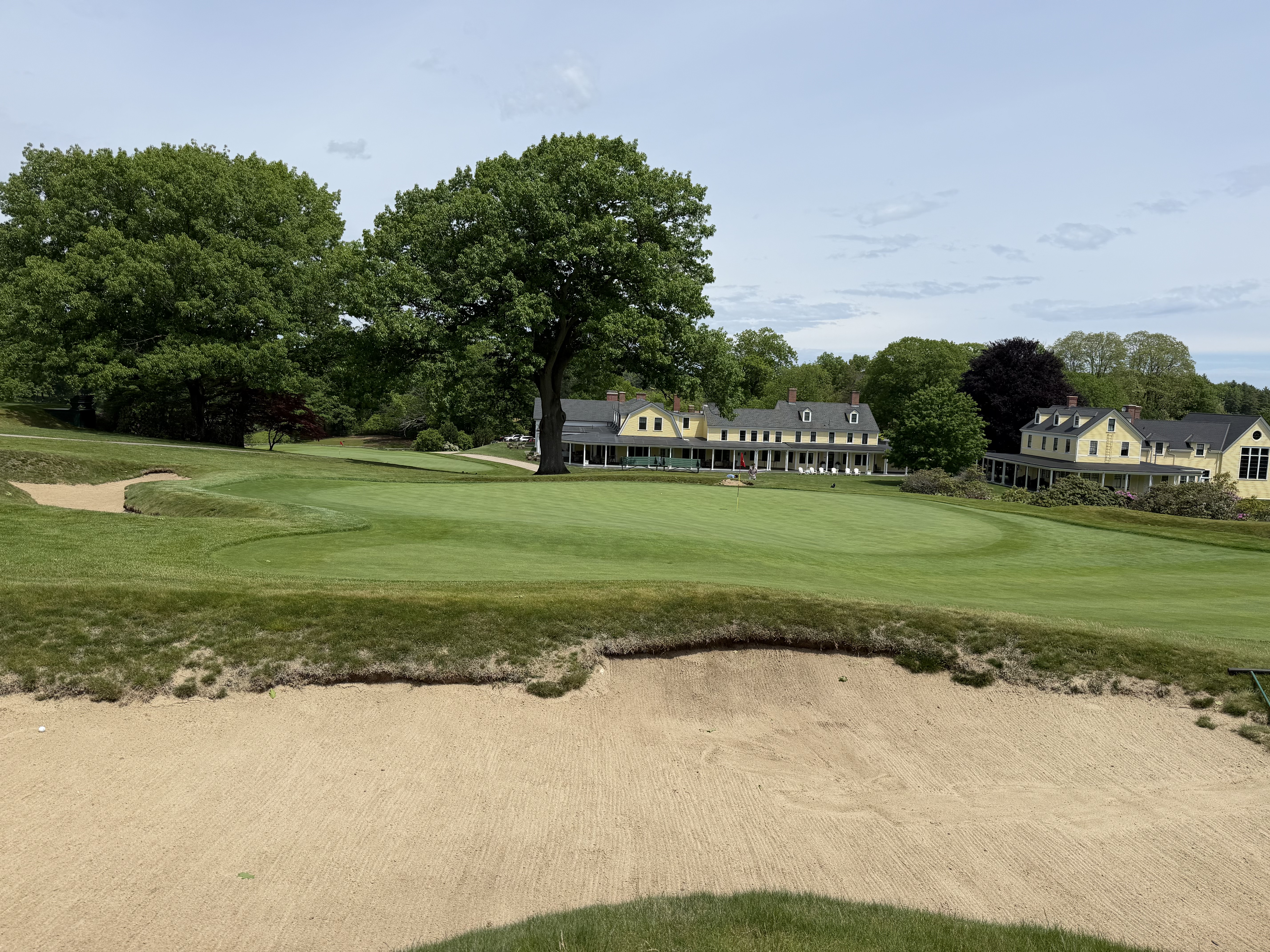
The Eighteenth is a 426 yard par 4. We tee off mere steps from the First green to finish things off. The prevailing wind will be against us the entire way in and with no fairway bunkers to consider, the trees on both sides ensure a true final shot from the tees. The trees yield about 50 yards from the green with a big old entry point for those wanting to keep it below the wind. The green seems to expand at the corners, opening up pin position possibilities and bringing the bunkers more into play for those trying to rattle them. Things are opened up, however, providing some refuge for those thinking of a conservative finish.


The back nine lives up in how it uses hazards, diversifies its sequencing and excels with its hazard placement. Certainly the better of the nines in my opinion, I would rank them 12, 13, 14, 11, 10, 15, 18, 17, 16.
Generally, Southward Ho is yet another very educational design on flatter terrain by Tillinghast. Here, hazard placement and angles are even more pronounced and the greens emphasize this concept as opposed to being the main anchor of character. There’s a nice mixture of aerial and ground approaches here as well, all done with mostly pushed up greens running back to front. As perhaps his only iteration of a links course and its proximity to the bay, Tillinghast held to those strategic components in general while side-stepping some back to parkland character for the sake of variety. In turn, it’s a unique layout with a lot more variety and strategy in the approach angles than one may notice or care to heed to while in the thick of it. It would be nice to see the restoration completed, especially at the Ninth, which will only enhance this unique character. As it stands now, however, there is enough here to make it a solid play amidst some noteworthy Tillinghast design.
Clubhouse/Pro Shop: The clubhouse and pro shop are separate structures but both have the Long Island coastal charm that’s appealing to take refuge in after the round. As mentioned, the windmill is a top flight logo.


Practice area: The range is right next to the First tee while the putting green is on the other side. There appeared to be a short game area between the Tenth and Seventh as well.



You must be logged in to post a comment.