6,884 yards, 130 from the Black tees
Without fail, I’m up before the alarm goes off. Takes a couple seconds to come to my senses, then I realize what has already been mapped out. Get dressed in the dark and quiet. The coffee is already on, grab some and before I know it, am moving along the dark streets in my car. Most everyone is still asleep. Finally on the highway and it’s empty save for a truck here and there. I might still be asleep, who can say. Slowly it gets lighter, slowly more cars appear around me. Still, it’s so early that ahead is only open road. It stays that way until I get where I’m going. When I get there, the roads and houses are mostly quiet, just like the ones I came from. Finally there is more stirring. Businesses start to open, a few people are out and about. I have time so find a breakfast place near some train station. They know the regulars and don’t pay much mind to me and my French toast. It’s finally time so I make my way to the course. I get there, one of the first few cars in the lot. Shake hands and introductions and before I know it, I’m on the First tee, the entire course before me as it too starts to wake up. The quiet continues except for a leaf blower every now and then in the distance, will likely stay quiet until the last few holes, when everyone else will finally start their morning. A couple hours later, I walk off the final green as groups are warming up, waiting for their turn at the opening tee. The entire day is at my disposal, I start to think of what to do next but of course I already know. Don’t we all?
The very early drive for the early morning round. One of life’s finest joys.
So it was on the day I visited Wheatley Hills on Long Island. Some may wonder why it is I do what I do with all the early morning forays and the answer is peace. It is when the world feels, just for a little while, at peace. That’s what golf courses are, after all. Pockets of peace. Pockets of peace tucked away amidst the chaos. The golf was indeed peaceful at Wheatley Hills that morning as I came upon each hole as if I was the one to discover it. Devereaux Emmet designed the first nine holes in 1913, with the second nine opening the next season. Similar to Oakmont, bunkering was not installed until quite some time after opening, allowing some time to observe play and figure out ideal placement. In 1931, however, Emmet made significant changes to the course, which included adding five holes in place of some that were lost during the construction of the Northern State Parkway. The course then remained intact for quite some time. Like so many other courses in the 1960’s, however, it was part of the Green Belt Movement and saw thousands of trees planted on its premises. The trees critically changed the course, in how it played and in how grass of the greens and fairways grew. The early 2000’s ushered in a new era as the club retained Hurdzan and Frye to perform renovation work in which they mainly focused on the bunkers. Extensive tree removal allowed growing conditions to once again flourish and with the design changes, a renewed strategic challenge.

A discussion of Wheatley Hills should start with the greens, which are very well placed. Their variety of locations on high and low points makes for a lively round while the shaping probably shows more Macdonald influence than most all his other courses. It’s a traditional parkland structure of play and presentation yet it is refined and thrives in that context. The tee shots are inviting to a wide fairways for the most part while the approaches vary in length and necessary precision. The golfer must know the nature of the contours because it is not enough to hit the green, not by a long shot. The ball will tumble and roll all over and even if it rests on the green haphazardly, there is most often much work left putting. A lot of the strategy entails navigating the hills, ridges and contours in a manner consistent with the golfer’s style of play. The contours and undulations are intelligently used, which in conjunction with the green sites, makes for an elegant and pleasant course. The more Emmet designed courses I see, the more convinced I am he was a master of ensuring the character of the course reflected the character of the natural setting. That is certainly the case here.
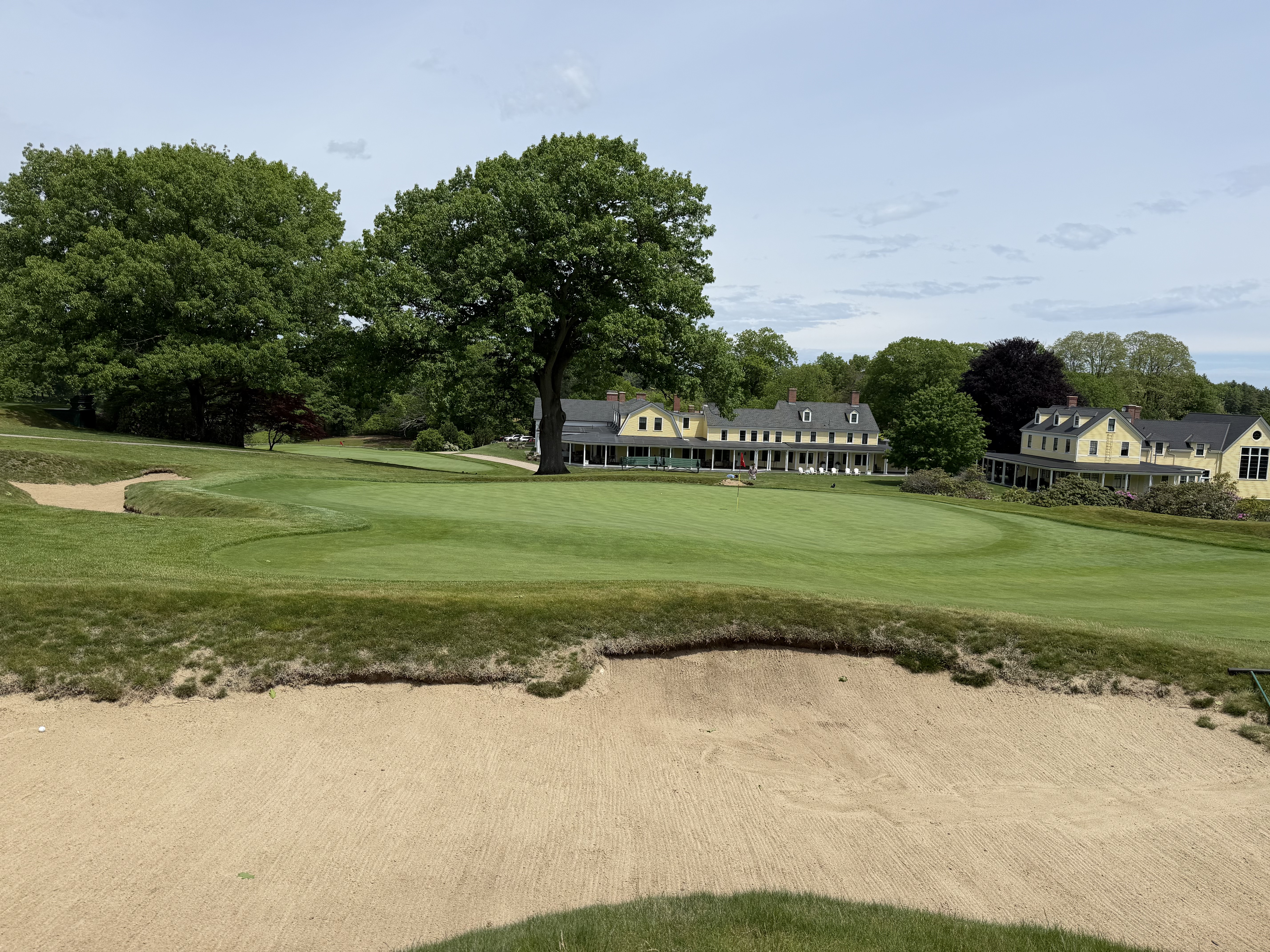
The First is a 342 yard par 4 (from the Black tees). The putting green is just behind the clubhouse, which stands above the arena of the course. The opening tee moves out to 10:00 left, a nice defined rectangular fairway moving uphill straight out of view. The left side is out of bounds with the tree line as the guide while trees are further up on the right just after the fairway bunker on that side. The fairway is generous but needs to be hit. A shorter approach awaits with the fairway feeding right into the green, a larger affair that sets the tone on what to expect on green size throughout. The interior contours should be taken seriously while anything off the rear will be a tough recovery back on. A nice introduction to what lays ahead.


The Second is a 367 yard par 4. The left side remains out of bounds but with the left to right cant of the fairway, a bit of favor on that side off the tee will make sure the golfer remains on the fairway and out of the trees on the right. The approach is a great one; moving left and on top of the hill at the end of the fairway, it too runs left to right with some risk of running off that right side if the ball rolls too aggressively. The left fairway bunker is original, the sharp lip hovering over the sand. The approach is when the course ramps up its demands on the golfer, thereby giving notice. Time to start playing well.


The Third is a 210 yard par 3. Alas, the demands continue with this longer par 3 to an elevated green that runs off on all sides. A gully lies between tee and green and the bunkering scheme here is smart as the apron and front corners of the green are all guarded, as well as the rear. The green moves front to back but then ramps up on the rear side. It’s an extremely good long par 3, one of my favorite holes of the course.


The Fourth is a 568 yard par 5. The interior of the course flattens out here, so the tee shot is straight out into the fairway. Contours and trees challenge the golfer with a bunker on either side of the fairway challenging the longer hitters off the tee. Most second shots should focus on getting past the left bunker, at which point the fairway opens to the green. And what a green complex it is. Using the entire hillside, the green moves right to left and back to front. With no impediment in front of the green, the golfer has full reign to do as he wishes to get the ball close to the pin. The ground game excites here.


The Fifth is a 538 yard par 5. Back to back par 5’s in the middle of the front nine, this one moving back in the opposite direction with a slightly elevated tee. The hills moving downhill can advance the tee shot closer to the green if the golfer can get the ball there while anything sideways likely ends up in a myriad of issues. A trio of bunkers breaks up the fairway from the green while greenside bunkering on either side accentuates the left to right movement. A bit more accuracy needed on this par 5 than the prior.


The Sixth is a 220 yard par 3. Some of my favorite greens seem to rise out of the ether, as many of them seem to do at Fox Chapel. Here from the tee, the green is in the open field, the tees upon the hill out yonder. The green is at grade and bunkering on either side below while the tees play on various angles in. Yet another long par 3 where the challenge is versatile depending on the path chosen by the golfer.


The Seventh is a 539 yard par 5. It was at this point I started to wonder where all the par 4’s were. We had not seen one since the Second. There are only three par 4’s this nine, which was heaven for me since I love the ying and yang between the 5’s and 3’s. The tee shot moves in the same direction as the Sixth as we now move through the interior to the other side of the property. A dog leg right which the golfer must start to negotiate at the second shot, the turn turns into a climb up to the green, which makes for a blind approach. Indeed, the second shot becomes vital in setting up the approach when considering the hill upon which the green is set. There is a single bunker on the hole, reaffirming it is not the abundance of sand that matters. Just how it comes into play when needed.


The Eighth is a 153 yard par 3. A short par 3 made shorter as a drop shot. Bunkering on either side and the green moves decidedly back to front. A very well done short-ish par 3.


The Ninth is a 426 yard par 4. Both nines run back to the clubhouse. Here, we are on the right while the Eighteenth runs parallel to us on the left. The right side is out of bounds as it borders the driving range but otherwise the tee shot is flexible and inviting. The bunkers are large both in size and depth. With the elevated green, the approach also plays longer than it looks, so clubbing up isn’t the worst idea especially with those bunkers aching to get a hold of your shot. The green is another slick back to front, so try to stay below the hole.


The front nine features a good amount of par 5’s and 3’s, taking what the land gives and maneuvering with the Parkway when needed. As it stands, the nine moves well, taking advantage of the interesting undulations of the site while maintaining engagement smartly on flatter land with at and below grade features, which are used effectively yet with sufficient restraint. I would rank them 3, 2, 4, 5, 7, 1, 6, 9, 8.
The back nine starts with the 207 yard par 3 Tenth. Another pushed up green on relatively flat land that runs back to front and left to right. The bunkers on the side flank the sides of the green, which creates additional movement on those edges. Also lots of room to use short of the green.


The Eleventh is a 462 yard par 4. A nice warm start to the back nine turns brawnier with this longer par 4 that happens to be the number one handicapped hole. The right side is now out of bounds and there’s a large flat bottomed bunker on that side as well. This is enough convincing for the golfer to favor the left, but the lone tree complicates this dance between the sides. Length and accuracy is needed off the tee to stay in scoring position. The green is straight out after the tree so a nicely hit tee shot provides a clear approach, albeit longer for most. The awakening at this nine is now.


The Twelfth is a 533 yard par 5. Great, sound architecture makes the most out of the natural features of a site and in the best examples, a single feature is the anchor for the entirety of the hole. The crest in the middle of this hole is a splendid example of a feature defining the character of a hole multi-dimensionally. The fairway provides room for the tee shot then narrows as it climbs the crest as trees on both sides help in that regard. The other side of the crest starts to move downhill and widens. Even the left side meshes with the Thirteenth. The fairway then runs into the green, which is slightly pushed up and features an upper rear tier that moves around the right to the front. It’s just as tough as reaching it in regulation.


The Thirteenth is a 329 yard par 4. The longer last couple of holes means we get a shorter par 4 now. Moving in the direction of the hole prior, a slightly elevated tee shot needs to stay between a narrower fairway with trees on both sides. The green is raised with bunkers lurking both on either side at the front and moves back to front. The green is a good one as it’s raised well above grade and its rounded edges mean the ball can move off and down pretty much any where.


The Fourteenth is a 186 yard par 3. A slightly elevated tee shot to an at grade green where the entry point is off to the right. The bunkers are well positioned in tune with the green movement so that the tee shot must account for them or else even some shots that hit the green could end up rolling off and into one of the bunkers. Subtle in its deception.

The Fifteenth is a 618 yard par 5. Back to long long long. A slight dog leg right that moves uphill, punctuating the length. The fairway tilts way up on the right side, so those who can make it up there on the second shot and move over are rewarded with a nice downhill towards the green, which helps the approach. The fairway keeps moving up to the green, which has some sophisticated contours, one of my favorite of the course. A long hole that doesn’t seem as long as it is for some reason, probably due to the absence of unnecessary impediments from tee to green.


The Sixteenth is a 343 yard par 4. Now at the interior in the area of the Sixth, we start heading in the direction of the clubhouse. The tee shot is downhill into a valley with a little more slope on the left side so that those opting for that side can see more roll than the right. The green reminds me of that at the Thirteenth with how well it’s pushed up and works with the larger below grade bunkers. It simply demands attention of its contours, which then moves to the edges with their fall-offs. In that way, the entire green comes into consideration no matter the approach or putt.


The Seventeenth is a 406 yard par 4. Still moving in the same direction, there’s a larger bunker on the right to account for off the tee. There’s a center line bunker that splits the fairway on the approach. As one gets closer, it becomes easier to discern it’s a Principal’s Nose, an original Emmet bunker and Exhibit A of the influence Macdonald had on him. Enjoying its prominent position, views of the green are obscured but the golfer doesn’t mind. The green is indeed on the other side, bunkered on both of its sides. A great par 4 because of, once again, a single feature.


The Eighteenth is a 437 yard par 4. The clubhouse is in the distance, a bit difficult to believe we will be at its feet in a couple shots. The hold bends to the right more than it dog legs with trees on the outside of the turn. The approach will be a long one in. Emmet liked his grand finishes and with the larger green one of the tougher on the course moving right to left, the golfer must fight to the end.


The back nine has a couple more hills to work with than the front and uses them well, yet once again transitions to flat terrain nicely. I would rank them 12, 15, 13, 17, 18, 11, 10, 16, 14.
Generally, Wheatley Hills is sophistication in simplicity. With remarkable restraint and effectively anchoring one or two features to a hole, the character exudes from brilliant placement. The greens were most impressive, placed on some of the more naturally endowed locations mainly the first few holes, with the rest then varied at grade or in degrees of pushed up steepness. It’s a wonderful set that move with that befuddling mixture of mischief and elegance, where frustration and incredulity never enter into the equation. The golfer is pleased to simply see his ball moving about in a some what majestic manner that he becomes indifferent to whether the ball decides to drop or not. Emmet’s Macdonald influence is primarily seen in the bunkers but is perhaps more effectively seen in the fairway shaping with their subtle slopes and contours. The golfer’s intimate knowledge of them certainly helps improve getting around more and more. In all, Wheatley is a very good rendition of Emmet’s design concepts on a more traditional parkland playing structure.
Clubhouse/Pro Shop: The clubhouse sits atop a hill overlooking the course and the pro shop is of course well stocked.


Practice Area: The driving range is next to the First tee while the putting green is almost on the clubhouse dance floor.


You must be logged in to post a comment.