6,562 yards, 123 slope from the Blues
While 2024 is full of wonderful memories at some of the most famous golf courses in the world, one of my fondest rounds of the year took place at old Shenny. Pulling into the parking lot and changing in my backseat (happens a lot more than I care to admit but I have a pretty big backseat), I only knew there was a lot of Donald Ross design left here and it was on my way to Newport. For those who don’t know, the Donald Ross Society is an excellent resource to determine where a particular course stands on how much Ross character is still intact. While some courses like to highlight an association with the man, it is surprising just how loose that association can be. The DRS exposes and validates as needed. It doesn’t take much to get me to one course or another but location and pedigree got me into that parking lot. As I sauntered from the lot to the pro shop, I briefly stopped in the grill and grabbed a water. It was a decidedly hot, humid summer day and the walk would be a sweaty one. After hours in the car getting here, I was fine with that. Roaming was in order after so much time crammed on I-95. The company of my foursome, which changed a few times, as well as the course and in particular its routing, made for a splendid summer time memory. This is how golf shows its strong suit. Where else on earth could I venture to some unknown corner, spend a few hours with complete strangers yet feel at ease as soon as we shook hands upon meeting than at a golf course? And how comfortable we all fell in to discussion for that time as we dealt with the fascinating struggle of the game in our own ways? Rooting each other on, consoling one another as needed, inherently knowing when nothing needed to be said and let the man have his space. There is nothing like it other than our game. And I had just as enjoyable of a round on land and with people I did not know as I could with such familiarity intact.
Shenocossett is one of the oldest courses on the east coast. Originally known as the “Griswold Golf Links,” it began as a course in 1898. Thomas Avery inherited the land from his father and constructed a four hole course. He eventually sold the land to millionaire Morton Plant, who then retained Donald Ross to undergo a complete re-design in 1916. Ross then returned in 1919 to remodel three of his own holes. The course has hosted a number of legends throughout its history, including Hagen, Glenna Collett, Alex Smith and Arnold Palmer, who would frequent the course while he was in the Coast Guard Academy. The routing starts on higher land before making its way down to the water, where the Long Island Sound and Thames River meet. The course grabbed my attention as early as the Second, where you need to carry the railroad tracks that front the green, then really kept its foot on the gas until the Eighth. The Fourth is a notable par 3, the green set on a hill. For those that like to associate Ross with turtleback greens, look no further as the entire hill operates the same way, even if visually it appears to be a gentler volcano green. The latter holes transform with the landscape as the course moves towards the water before a really good closing par 5. Angles, blind shots, fescue and deceptive greens; it’s all here and the course plays really well in conjunction with the terrain. A lot of the Ross design is still left, yet holes 8, 9, 15, 16 and 17 were re-designed after a land swap decades ago. There are efforts at restoration as they have aerial photos from the 1930’s and there is some strategic bunkering that could be re-installed but as it stands, it’s a pretty good muni with lots of Ross character and a pliable structure of play. All this at a reasonable green fee and you only have to root for places like Shenny thrive for the side of the game they highlight in the U.S.; affordable, accessible, meaningful golf.

The round came to a close as the sun began its setting ways. A bit cooler and a prevailing quiet that seems to happen as the haze of evening starts in, our group could have passed as close friends as we walked to the final green. After accounting for all of our last strokes, we shook hands heartily, knowing our time together had come to an end and very likely would never see each other again. That was not the point. We all knew the spirit of the game was with us and indeed, our celebration of such spirit with completely different fellows of a completely different time and space meant we would always share such unison together. In that way, we knew in no uncertain terms, it was not goodbye at all.
The First is a 345 yard par 4 (from the Blues). A dog leg left where the tee shot carries over Plant Street, one needs to decide just how much to take on before the turn. The green is slightly uphill and a bunker runs across its front, which makes most approaches aerial. A simple bunker placement changes the hole dramatically.


The Second is a 384 yard par 4. The tee shot moves downhill and there are no bunkers to speak of except for one on the absurd short right that if one finds themselves in, it was due to an absurd miss they should forget about immediately. The fairway begins to narrow and ends altogether at the railroad tracks. The green is above on the other side. Nothing like a good set of railroad tracks on a course, a rare relic in the U.S. The green is set against the Third tee and a bunker lines the rear while the front side falls off to the tracks. So if the need arises, miss left. Otherwise, a healthy tee shot and the downhill should mean a shorter approach in to help nail the green.


The Third is a 397 yard par 4. The holes are getting progressively longer and we are now faced with a blind tee shot with bunkers on both sides of the fairway. Aiming over the right side bunkers should get the ball rolling down the hill towards the green. The green is a larger affair and has a Road hole fee with the OB fence running close to the rear. It moves quickly from right to left, so much so that favoring the right side on the approach is almost critical.


The Fourth is a 208 yard par 3. A really impressive volcano hole and on the longer side, the golfer needs to work at getting ball up to the green and make it stay there. The slopes are strong and there’s the very real possibility of the ball moving back down the hill. There is more green than it appears from the tee and falling off the rear is more severe than the rest of it. One of the golfers in our group told me a story about Arnold Palmer and this hole but I forgot what it was. He either ended up with a high score on this hole once or was on television playing the hole, I apologize for forgetting the specifics. A very strong par 3 regardless.


The Fifth is a 555 yard par 5. I can’t prove it and this hole may not have been the original Fifth or a par 5, but I think Ross secretly reveled in the Fifth holes of his courses being par 5’s. It just seems too coincidental. Start paying attention and join the madness. There are a row of bunkers that need to be carried off the tee not readily visible and the general cant of the fairway is left to right. Those who are able to pull off a nice tee shot will have a realistic option of going for the green in two, so long as they favor the right side and figure out the correct roll out. Well placed bunkers near the green are enough for the golfer to reconsider and set up the approach a bit more carefully with the extra shot. The green moves to the left, strongly.


The Sixth is a 421 yard par 4. Moving back towards the Fourth. In fact, the green is on the back side of the hill upon which the Fourth green is, directly adjacent. There are some below grade bunkers that the longer hitters needs to concern themselves with, just before the maintenance road. The tree is wide and shallow and at the base of said hill. Like the Fourth, there is room to mess about on the hill but do not go long.


The Seventh is a 431 yard par 4. A bit of a switchback in this wider meadow area as we return in the opposite direction, running parallel with the Fifth on our left. The tree line runs along the right side while a group of bunkers is stationed on the left off the tee. The fairway moves gently downhill to the green, which is mostly encircled by bunkers. Most approaches will be aerial because of the bunker configuration. In fact, all of them will be. The swirly nature of the bunkers is interesting and allows some room between them and the green surrounds but the approaches will need to carry nonetheless.


The Eighth is a 490 yard par 5. The tee shot heads uphill and makes the shot blind and there are three bunkers in succession near the center of the fairway. After those three, the fairway continues downwards to the green with yet another series of intricate bunker placements. Succinctly, as one moves to the green from those three bunkers, they appear on the left, two in succession at the front right, then another at the left of the green. The green is relatively perpendicular to the fairway and the successive bunkers at the front right will need to be carried for most approaches. really, the only approach that will not need to be aerial is any shot after the left side bunker before the green. All of this of course makes the second shot pivotal in setting up an ideal approach to handle such configuration.


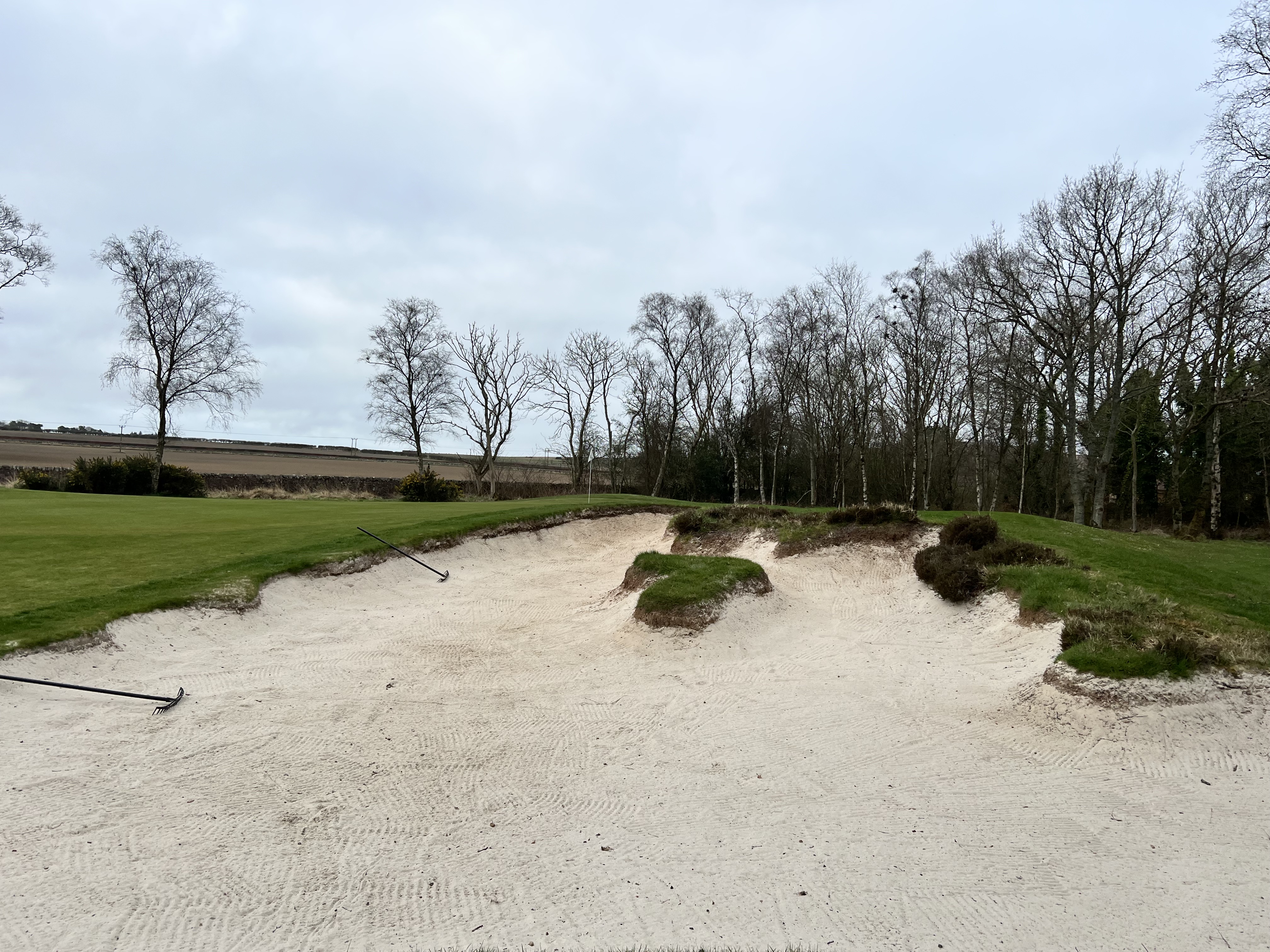
The Ninth is a 175 yard par 3. We’re starting to learn the crafty nature of these bunkers and how they “cone” shots to the green. Yes there is width but the bunkers mandate carries and roll out risk so that ideal approaches are within a much more exact window. This is done without foreclosing freedom of thought, however, as the golfer can still think or try various shots catered to their playing style. Here, there’s a relatively large cone with the bunker front left and two on the right allow the golfer a relatively straight shot in, or can shape and carry the sand on either side. The green moves back to front with some right to left.


The front nine is economical with the space it takes up yet utilizes the modestly rolling terrain well. There is a variety of holes and how they should be played is varied yet thematic all at once. I would rank them 4, 8, 5, 3, 2, 1, 6, 7, 9.
The back nine starts with the 425 yard par 4 Tenth. Teeing off across Plant Street, the fairway cants to the left more than it appears at first blush. A bunker appears on the left near the start and further down the fairway while the approach is to a pushed up green with a wide open entry point while bunkers encroach from the sides. With the edges moving away from the green, it’s a tougher approach.


The Eleventh is a 385 yard par 4. The abrupt hill after the tee means the tee shot is blind but there’s not a whole lot to worry about with the fairway. There are no bunkers to speak of and there’s a good amount of width. The prominent bunker at the green is on the right, below grade and wrapping around that side. The movement at the green and fairway remains the same as it was the hole prior; right to left. That brings the greenside bunker more into play as approaches need to flirt with it in order for the proper roll out.


The Twelfth is a 125 yard par 3. Just about every Ross design has a short par 3 and this one is to a raised green relatively blind from the tee. The right side is high and left side low, a triangulation of bunkers at each side and rear.


The Thirteenth is a 353 yard par 4. Another uphill tee shot that leaves the golfer in the blind, wondering where his ball has gone off to as he starts traipsing up the fairway. Bunkers are more aggressive than normal about the sides, especially at the green. The green is situated on the hillside we first encounter at the Tenth, making any shot long tumble down the bank, well below the hole. Another tough approach, probably even tougher than the Tenth.


The Fourteenth is a 418 yard par 4. The fairway is relatively free to lash away at but there are a couple leggy bunkers on the left that could come into play rather easily. I suspect the green used to be located more to the left in what is now long grass and bushes but now it is further down and to the right. A center line bunker is about seventy yards before the green and I would probably be the most annoyed if I ended up in the bunker at the rear of the green. The entry point is generous but it’s still yet another tough approach.


The Fifteenth is a 195 yard par 3. We now move to the other side of Eastern Point Road. A generous apron before the green that turns a little into the green with bunkers at the front corners. We’re seeing a pattern here. Despite the generous apron and entry point, hitting the green is tougher than it seems, which depends on the “cone” the golfer decides on trying for.

The Sixteenth is a 400 yard par 4. A dog leg left where the tree lines of all things plays with the golfer. The left side crowds the tee shot yet those who flock to the right will be met with trees on the right. Either way, one must get close to and maneuver about them despite the fairway width. A trio of bunkers lines the left of the fairway in succession then two on that side next to the green. This leaves the right side open so long as one doesn’t end up in the trees. The green is pushed up and once one is able to walk up to it, the splendor of Baker Cove is finally revealed. Use the width on the right wisely.


The Seventeenth is a 345 yard par 4. It’s a brief visit with the Cove as our tee shot here moves back inland towards the clubhouse. The left side is snug and a general sense of narrowing prevails here. The tree line that menaced on the right hand side at the hole prior is menacing once again on that side, blocking out approaches too far over on that side. Drive doesn’t necessarily have to be the club here, it is much more about placement and a clear line to the green on the next shot. The green is above the fairway on the hillside, back to front movement prevailing. It’s a wily shorter hole.


The Eighteenth is a 500 yard par 5. The final hole typifies the design character of the course. Terrain undulation with playful and some what deceptive bunkers placement that instills strategy into each shot. The fairway moves down and to the left from the tee, which means most tee shots will be in the blind. Favoring the right side makes the hole play a bit longer but reveals the green sooner. The green lies perpendicular to the fairway and falls off on all sides. Bunkers surround it well except for the front right where the entry point is allowed to come in and can be used on approach. Some second shots will also be blind, especially if the golfer decides to go for the green early. The green could be in reach more easily than one thinks with the shot playing downhill and without seeing the green, some times it’s easier to decide to go for it, hit and hope. A worthy finisher.


The back nine plays a bit stiffer than the front. Width conspires with sand to create some tough approaches alternating with tough tee shots and an abundance of recovery character to get back into position if needed. I would rank them 18, 12, 17, 16, 10, 14, 13, 11, 15.
Generally, Shenocossett plays nicely as is but it would be great to see restorative efforts materialize to realize more of its potential. The soul of the course is its strategic bunkering placement. It does well in having the golfer guess about carries and roll outs and even angles in attempting to negotiate them, all while plenty of width seems to be at the golfer’ disposal. Restoration plans include reinstalling the some more of the bunkering, which would only enhance its very core. The pragmatic routing uses every corner of undulation, which is most evident at the greens. A nice, sporty Ross design in a clever arrangement of width and narrowness with a notable balance of bunkering. Shenny is one of those courses that has the potential to take the same path as Jeffersonville or Southern Pines if it is so inclined. The design structure is there and its current play is very good, so we shall see.
Clubhouse/Pro Shop: The Par Four Restaurant draws golfers and non-golfers alike while the pro shop is just down the hall closer to the First hole.

Practice area: Short game area and putting green. It’s New England and with these older courses, driving ranges mean finding new space that just isn’t there some times. Just stretch and do some of those slow motion swings to warm up.


You must be logged in to post a comment.