- Red: 3,300 yards
- Blue: 3,341 yards
- White: 3,149 yards
- Red/Blue: 127 slope – Reviewed
- Blue/White: 123 slope
- White/Red: 125 slope
- All from the Blues
Don’t just play the publics but travel to them as well. There’s so many good ones out there. That was certainly the case when we came upon Timber Point in South Central Long Island, which rests on the coast of the Great South Bay. It’s rather well known, or at least should be, as Harry Colt and Charles Alison designed the Red/Blue eighteen in 1927. Colt and Alison had the Bay and adjacent wetlands at their disposal, which includes some rolling topography and larger hardwoods inland, to configure in conjunction with the wind that routinely runs through. The front is the Red and starts in the hardwoods and meadows, then begins to creep in the wetlands towards the closing holes before the Blue back nine takes over, which then whisks the golfer to the harbor and bayside, where he is completely exposed to the whims of the wind and the structure of play completes its full transformation from parkland to links. In 1971, a third nine was installed by William Mitchell, which impacted some of the Blue holes and caused some re-routing. Originally, the Tenth (or Blue 1) would move directly towards the Bay, then the Eleventh would ride the wind towards the “Harbor” hole (current Blue 2). These original first two holes of the Blue were eliminated with the advent of the White course. As it stands, however, twelve of the original Alison eighteen holes remain in place on Red/Blue. It was likened to Pine Valley for the Red and Cypress Point for the Blue.
A Golden Age classic on prime environs that is accessible to all on Long Island seems almost too good to be true. Indeed, the Blue has better golf than some of the private courses on the island. There is a good amount of original work in place (fourteen original greens) and the opportunity exists to restore the original Alison eighteen. Similar to Bethpage Black, Cobb’s Creek and the like, such a restoration is seen by many to have significant potential to elevate Timber Point into the discussion of one of the better public courses in the country.
Frank Pont and Tom Doak are the two I know of who have offered their services free of charge to undergo restoration. Frank Pont links his proposed master plan in a Golf Club Atlas link and anyone interested in learning more should track it down. Pont’s objective would be to return the course as much to the original design as possible, then add on a six-hole short course. Most all of the holes can be returned except for the Tenth. Due to sustaining a good deal of damage from Hurricane Sandy, Pont suggests raising the coastline holes an average of 2.5 yards. Bunker work would be part of it, as would returning many areas to the dune scape it enjoyed in eras past. Routing-wise, the changes would include taking the First more to the left, which would then leave the Second a par 4 to the first par 3 as the Third (currently the Second). 4 – 8 would remain intact (currently 2 – 7) and then the Ninth would start at the current Eighth tee, yet veer to the left near the current Ninth tee. The Tenth would then move through the interior towards the coast, then the Eleventh would move towards the harbor where the existing Blue 2 is. 12 – 17 would remain intact (currently Blue 2 – 7) but then 18 would move back to the clubhouse from the coast, its green directly adjacent to the new Ninth green. There are numerous situations where a property has too many holes on it, some how placed as changes took place and often contorted awkwardly so that it all fits. This is mostly at the expense of an inherent natural flow that the original, more spacious course enjoyed. The unfortunate JC Melrose comes to mind here, which I always felt could be an exceptional Fifteen-hole course. Quality is always better than quantity and while it would be unfair for me to say the White holes are inferior, I can say that Pont’s proposed restorative routing brings a lot of flow and ideal use of the land back.
As it stands in its current form, Timber Point is a pretty good play, taking the golfer through various natural settings that require various playing styles. The moderate to rolling topography is used well, especially about the coast line, but relies on angles and hazard placement in conjunction with a healthy dose of wind for most of its challenge. The greens were quite interesting with large swaths of movement intermingled with subtlety. The round moved well despite the larger group showing up the morning we played. In all, it’s a public course worthy of a visit and underscores the spoils of riches Long Island enjoys with its golf courses. Timber Point has the setting and pedigree, a good amount of which the golfer can now experience. Time will tell whether its full potential will ever be again realized yet hope springs eternal.
RED COURSE
The First is a 319 yard par 4 (from the Blues). The tee shot does everything it can to tell us the right is no good. Out of bounds remains close at hand through the green and then there are larger bunkers that come up in succession on that side. One can’t just steer for the left and all will be well. There are trees on that side and just enough width where one has to start considering tempting the right side a bit. Besides, the green is set on the right as well, so the age old adage of embracing trouble reaps rewards ends up applying here as well.


The Second is a 165 yard par 3. A pushed up green with a long bunker nicely sculpted along the left side of the green. Once again, the golfer can’t just avoid the tree line. Learn to flirt with disaster.


The Third is a 486 yard par 5. Out of the trees and into the meadows. Straight out with the tree line on the left and bunkers out to the right in the rough. With the next hole coming back in the opposite direction, it seems like a great opportunity to join the fairways and have the fescue and bunkers pop in when the mood strikes (after review of proposed Master Plan after I wrote this, this is exactly what is suggested). The simple yet effective bunkering continues near the green, parallel with the line of play and on either side, force the golfer to shun bailing short on the approach. With the smaller green and trees long, this becomes more complicated.


The Fourth is a 450 yard par 4. Moving back in the opposite direction, we’re not a little uphill with more width, especially near the green. Bunkers start left, then are to the right green side. If feels the need to miss, the right side seems like a better option since there are no trees on that side to block out the approach for the most part.


The Fifth is a 193 yard par 3. A longer par 3 where the green moves left to right towards the right side bunker. The golfer wants to avoid the larger bunker on the lower right yet the further left he goes, the more harrowing the movement back down the hill will be. Those shots ending up to the right of the pin will be in the best position.


The Sixth is a 389 yard par 4. Now downhill, there are two bunkers well concealed that cover most of the fairway off the tee. They must be carried; laying up short of them would leave too long of an approach. The green is pushed up and in conjunction with the downhill, makes for some what of a ramp with bunkers on either side lurking below. With its smaller size, it makes for a tougher approach.


The Seventh is a 556 yard par 5. The early dog leg left off the tee threads the wetlands on the left and water on the right all the way up to the green. The fairway is on the narrow side but there are no bunkers to speak of. The ball needs to stay straight; there is no dispensation for the sideways shot. The green is a tiled disc moving towards the right. The biggest challenge is calibrating the tee shot correctly. Otherwise, it’s a matter of staying straight.


The Eighth is a 427 yard par 4. We now move back and the water is on our right, with the hole moving around it. Navigating the tee shot between the water and trees on the left is the main challenge. The course is set up for the wind and here, the approach boasts width to accommodate whatever blows through. The 2-1 bunker arrangement is in place yet again near the green (we saw it at the Fourth), this time starting on the right before the green then left green side.


The Ninth is a 315 yard par 4. A shorter par 4 that bends to the right off the tee. It is two easy iron shots for the disciplined golfer, a hit and hope drive and recovery shot for the whimsical one.


The Red is decidedly parkland and starts off with holes that show simple yet sound design that are flexible with the elements yet grounded in strategic threads. The last three holes didn’t feel original in how they were placed around the wetlands and water, my guess is that they were part of the changes in the 1970’s. I would rank them 6, 5, 2, 4, 5, 9, 1, 8, 7.
BLUE COURSE
The First is a 484 yard par 5. A narrow strip of fairway moves between spots of water and trees to reach the green, which is choked by bunkers at its entry point. Situating the tee shot either before or next to the water on the right is primary, which then allows some decision making about where to put the second shot to set up the approach. We know it’s not an original hole and the path to the green seems hastily put together as a means to get to another part of the course. With that said, the green has a lot of nice interesting movement.


The Second is a 145 yard par 3. The harbor is paces away and the tee shot must carry an inlet to reach the green below. It’s wider more than it is deep, moving right to left more than anything. Lots of room to miss right as well. If anything, it sets up the nautical tones that dominate this nine holes.


The Third is a 382 yard par 4. The harbor is sheltered by Nicoll Island and the peninsula that fronts the coast. We now move away from the harbor so that we can head on to the peninsula and get on the coast line. The tee shot is unlike any before with its unbridled width and along with it, the wind is free to roam as it pleases. Just don’t veer too far left or else you’ll end up in water, which stealthily runs along the entire left side. In fact, staying a bit right is a better angle into the green so do what is needed with the wind to get on that side for the approach in.


The Fourth is a 433 yard par 4. Now we get on the peninsula. Right center is the play here, as the left side gets bushy with wetlands quickly, making it a bear to find and extract one’s ball. Fortunately, there’s a bunker we can take aim at from the tee and carry over as the best line. Likewise, the right side is a better approach into the green, as the left side encroaches a bit with all its sand and wilderness.


The Fifth is a 207 yard par 3. This is the famous Gibraltar hole, that takes us to the point of the peninsula. And yes, the green does indeed look like the Rock of Gibraltar off of the Western Mediterranean coast. Some resemblance. Both are on peninsulas as well so there’s that. At any rate, it’s among the most harrowing shots on the course. The wind is at its peak and the golfer has a long way to get his ball to the green and up on it. Any where to the sides is essentially dead unless it reaches before the green. Those who need to pitch on should think aggressively, as there is more room up there than it appears and the wind will be doing its best to send the ball back down. The green is a bit tilted but remains fairly straightforward. Mainly, because it doesn’t need to do much else. The golfer looks upon the Nicoll Bay and Sailor’s Haven down the horizon as wind and water are close at hand. It’s a nice place to take stock.


The Sixth is a 358 yard par 4. Now we move along the coast. There is some give on the right side which will be needed as one negotiates the wind coming in from whatever direction. At one point, it was to our backs and a few minutes later, was fully head on, so stay on it. That’s really the challenge for the tee shot is staying on the fairway, as there aren’t any other hazards to note. A bunker straddles across the fairway just before the green, demanding it be carried to reach the green. It’s deep enough to lash away and ensure you do so.


The Seventh is a 416 yard par 4. Still moving down the coast, the hole is arranged similarly as the one prior in that the fairway and even off fairway are all relatively benign, acknowledging that the wind is giving the golfer all it needs for challenge. There is one bunker on the right that runs parallel to the fairway near its start just to keep everyone relatively honest. The right side bunker near the green comes into play often as those hedge to the right off the tee. The left side bunker is slender and slings along the left side of the green. Those in it are likely thankful the sand caught it and stayed in play.


The Eighth is a 416 yard par 4. If one turns to the left when on this tee, they will see the White course. We move back in the direction we came, a bit more inland with each step. A little bit of a left turn off the tee then straightens out to the green, a bunker on the right, then another closer to the green. Stay to the right; the greenside bunker at the front left can be more of a bear that it seems.


The Ninth is a 490 yard par 5. Just like the First, the fairway is a narrow path between the ponds and trees to reach the green. Simply put, the holes from the clubhouse to near the water are a bit cramped and their routing could be improved, which is where the proposed restoration could really help. This hole is better than the First because of the hillside coming in from the right and the First tee area provides a little but more width. The green is uphill to the fairway with bunkers at either side.


The Blue is a delight in how it uses the peninsula and allows the ferocious randomness of the wind to take center stage. I would rank them 5, 6, 7, 8, 4, 3, 2, 9, 1.
Generally, Timber Point, at least the Red/Blue, takes the golfer through a myriad of natural settings that seep into the overall structure of play. The Red stays among trees before finishing in the wetlands and requires a rhythmic and thoughtful placement of each shot while the the Blue is wind and water, demanding that the golfer learn how to temper the force of movement in the air. Both nines allow liberal reliance of the ground. Most of what I suspect are the original holes, or something close to it, use the land thoughtfully even though the presentation is able to stay in refined simplicity. In all, there’s an animated round of golf here as is, yet some proper restorative attention could uncork a lot of the potential that remains dormant, for now.
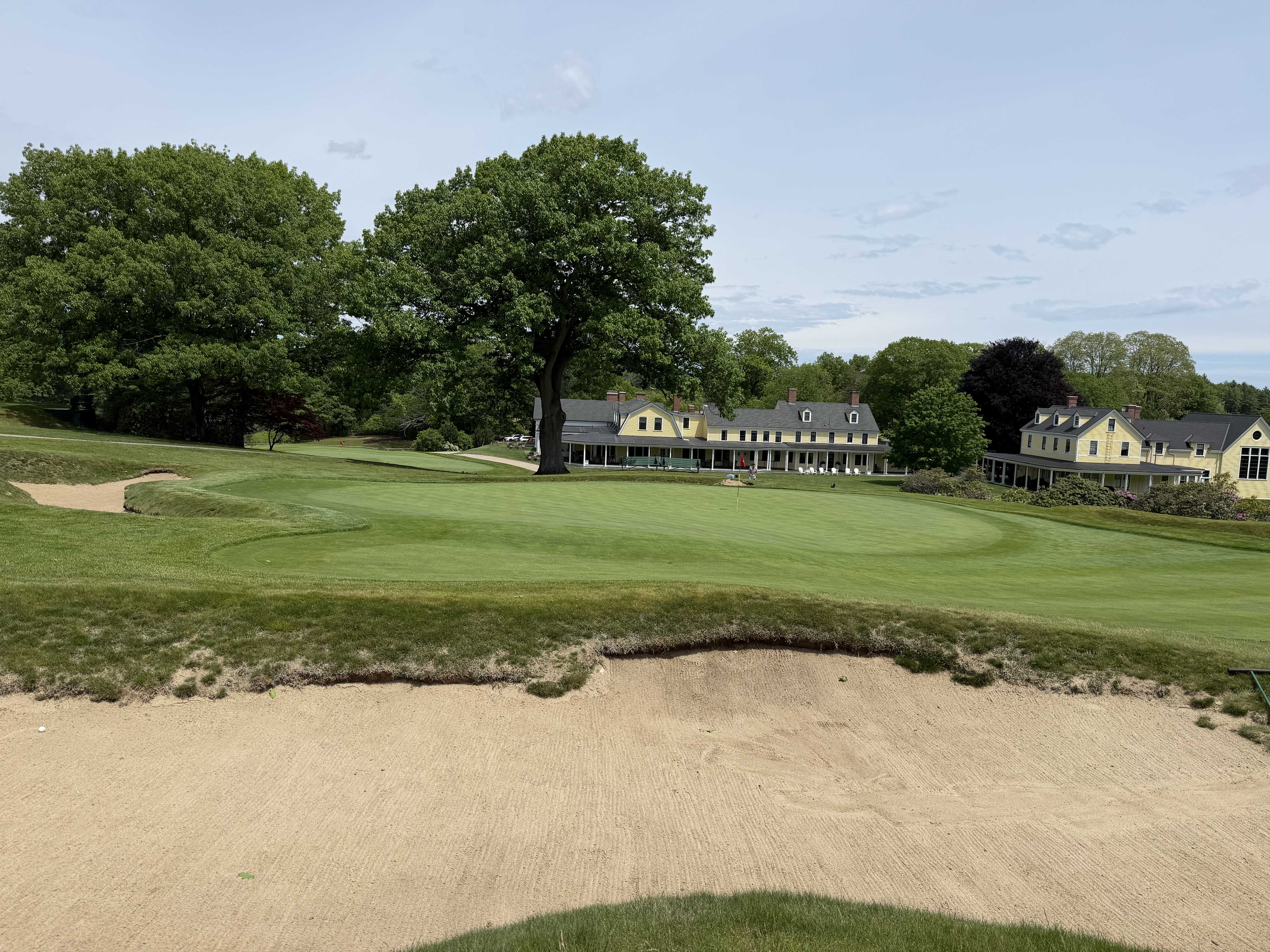
Clubhouse/Pro Shop: It looks the like a nice cottage from the front side yet is of decent size and has enough for any golfer.


Practice area: There’s a range, putting green and short game area.



You must be logged in to post a comment.