7,109 yards, 132 slope (Blues)
It’s actually the Great Trinity Forest. The largest urban bottomland hardwood forest in the country with the Trinity River encircling its outer reaches, the forest is comprised of a variety of trees and wildlife that includes hawks, coyotes, armadillos, feral hogs, bobcat and wild turkeys. Miles and miles of trees, wetlands and wildlife. And shade.
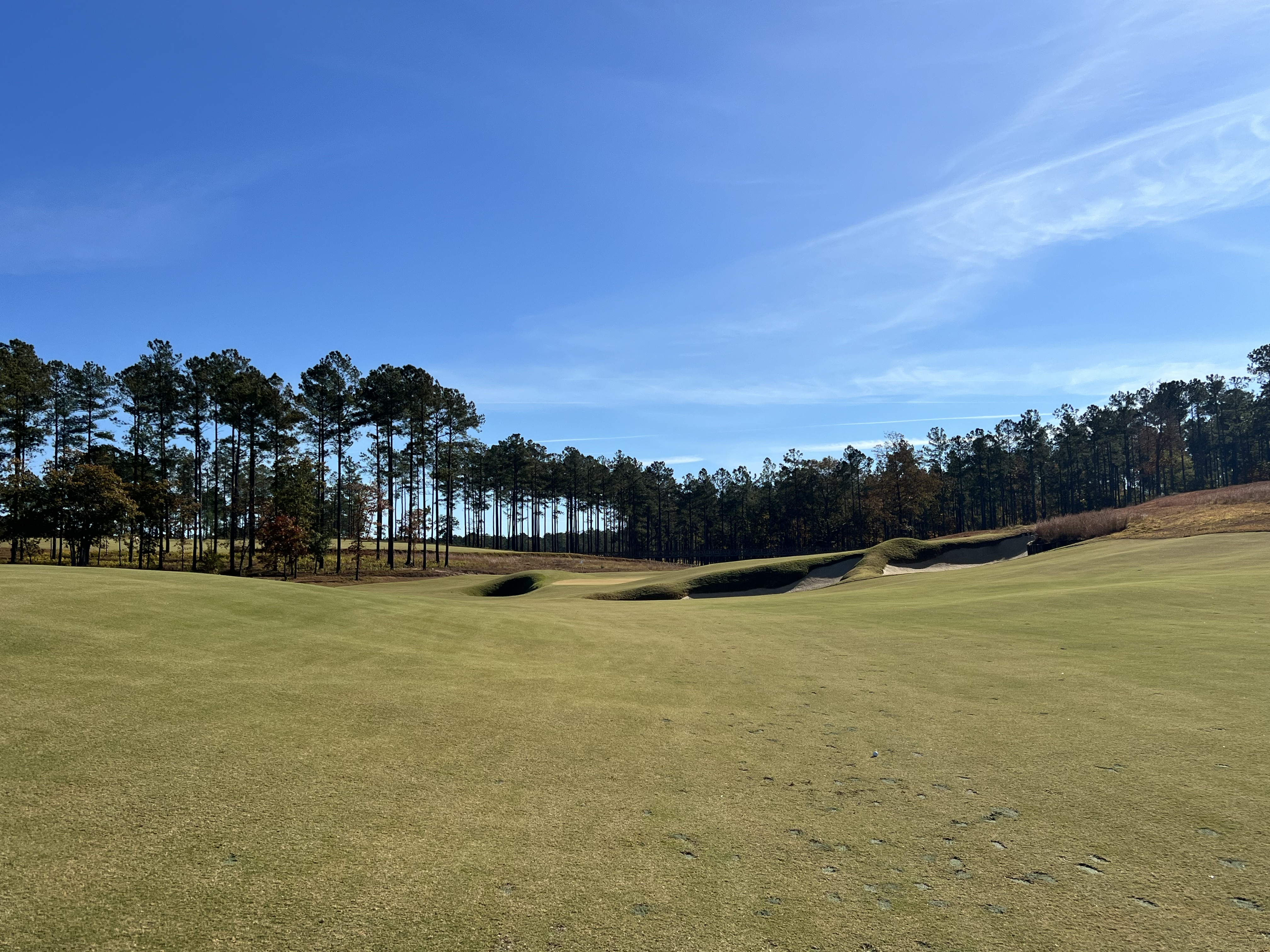
The opening tee shot of Trinity Forest the golf course yields none of the above. It’s intriguingly desolate with a lot of sun and sky pervading the foreground. At first glance, the terrain seems rather flat. The sun does its best to bake you into it while the wind doesn’t really cool; it more or less blasts the heat on you in several directions. It all remains in place as a comforting constant and as you start to move about the large open space, the ground is the only variable that changes in any way. Alas, the golfer is compelled to look to the ground to both situate and navigate himself about the course. The high prairie sears as the golfer must set his own foot on the land to understand its intricacies, which he will need when the wind comes calling. It is high up mainly because of its place on a landfill. Because of the landfill, Coore and Crenshaw were not able to dig in or below the ground nor could they plant any trees, so they needed to stay at the surface and any added features would be above ground. As Coore noted, “The focus had to be the rumpled ground created as the landfill settled over the decades and we tried to highlight those features.” A new strain of Zoysia was created just for the course, a shallow root hybrid that imitates fescue (fescue was used at Sheep Ranch). This uncorked the firm and fast conditions fitting for the site. It may seem to the golfer that his ball is lost in the horizon because of the vastness beyond when in reality it very well could be the ball has simply ran out of view. Like Sheep Ranch and Talking Stick to some extent, Trinity was a project where their canvas for creativity was some what limited and confined, as opposed to the freedom and space they had at other projects. Yet they thrived anyways.
The course plays like a links even if it is not in the traditional setting for one. Wind is prevalent here because of the lack of trees and how the ground sits higher up than normal. One could see how this largely barren, rasping wilderness is transposed into the design. It has opportunity for those who earn it and that means understanding what the land does and where it goes, then using skill to one’s advantage. The bunkers are milestones, the features and mounds almost a lifeline for the golfer to some how mark his way. The prairie links here is sublime. It all makes you start getting creative with shots and decisions because the course seems to invite it, or at least provide the temptation.
The course opened in 2014, which brings us into another decade of our design evolution progression. While the 2010’s experienced a strong trend towards restoration and renovation of existing work, new projects continued as well as complete re-designs that might as well be considered new. Regardless, most all design began to focus on interest over difficulty. Strategy over penalty. Firm and fast conditions continued to be sought after while width was explored more and more in varying degrees. In many ways, the design trends seem to be catching up to Coore and Crenshaw’s style, which were doing the above all along. Expressions of links also started to progress to a variety of natural settings, as well as more challenging sites, where advances in shaping and grass technology provided much more potential to those projects. Trinity Forest is unique in that the landfill site did not lend a natural setting, yet Bill and Ben treated it as such. In fact, even more so since they could not dig. The design enhanced the existing landfill site for sure, demonstrating the variety of environmental settings links structure was being used in, an absolute sign of the times.
The layers of subtlety Coore and Crenshaw exhibit through their work is staggering and Trinity Forest is yet another of quite a bit of depth and substance. While the land and how it’s used is typically transcendent in one way or another with respect to their projects, here it is more specific. It is the terra firma. One must recognize and appreciate its complexity. Considering what it was beforehand, the project is truly transformational. The profundity and versatility of their work is certainly on display here, creating a modern links masterpiece.

I came in to the round on a tear. A personal low score the day before and even playing well in the morning, I didn’t even blink as I tapped in for par at the First. Yet it was then the land began to work on me. Its immense vastness would swallow the ball into it and the terrain began to shift, slowly showing its complexity. The configuration of green to fairway and fairway to tee was striking. It took some adjusting all as the heat and wind did their worst. Yet in the end, it was a fulfilling and unique links experience brimming with brilliance at the surface, transforming a previous landfill site into unparalleled American West links. The options, the recoveries and the thinking were all richly wonderful and while I left with some semblance of knowledge of the course, I also know there’s much more out there in that expanse to be discovered.
The First is a 400 yard par 4 (from the Blues). Slightly uphill from the tee, the hole eventually bends to the right closer to the green. The left side expands and is where the room is while the right side runs relatively rigid. The right is the shortest path to the green and knows it as bunkers are all along it. To be fair, there is a bunker on the left, which narrows the fairway for a spell before expanding towards the green. The green complex is bunkerless and open. Open to an array of approach styles, as well as open to the wind. The greens are large so the relationship with the terrain continues with the flatstick and knowing more and more about the intricacies out there can only help.


The Second is a 537 yard par 5. Off to the right you can see the Great Trinity Forest in the distance. The tee shot is relatively benign unless you miss the fairway. A lot of my disorientation came from the immense width before me as we walked off the tee. The Twelfth comes in from the left and while a large center bunker creates some definition, figuring out this hole stayed to the right and how to navigate in the chute between bunkers up to the green took some getting used to. There is a lot of temptation to head for the much more wide open left side but the angle into the green from that side makes for a tougher shot in. The green accommodates our hole as well as the Twelfth, much wider than it is deep, pushed up a bit above the fairway. The contours can certainly be used to manipulate the ball closer to the hole while anything behind the green will drop off abruptly. A very cool hole that introduces the unique character here strongly.


The Third is a 205 yard par 3. One of the remarkable traits of Coore and Crenshaw is how they almost never confront natural hazards directly. They’ll sidle up to it, they’ll creep around it, they’ll sneak up on it, but they rarely ever present it dryly. Here is no different where a ravine bisects the property. Yes our tee shot needs to carry it but the hole runs up to the green on the ravine’s edge. This means the ravine needs to be carried but must be carried as close to not carrying it as possible. Those carrying the ravine too much are in trouble in terms of the green running away from them. Yes the whole concept can be contradictory at first but the golfer must do much more than simply get his ball across the ravine. In order to score, he must do so while flirting with it as much as he can muster.


The Fourth is a 458 yard par 4. Having crossed the property, we now head to the further corner from the clubhouse. The hole leans against the tree line on the left while eventually cresting right closer to the green. There are some mild forced carries off the tee and approach that you could probably hit out of if need be. The green follows a similar configuration as the fairway, with the left side shored up with bunkers while there’s plenty of room to work with on the right. It’s almost as if the hole wants your ball to go into those tress on the left and you have to fight against that fate.


The Fifth is a 592 yard par 5. The journey to that corner continues. Coore and Crenshaw are one of the best at designing adventurous par 5’s and the Fifth here is among them. A trio of bunkers stealthily cross the fairway, gradually and at an angle that start from the right side and end up with a few larger ones on the left. After that row, the fairway bends to the right towards the green and all the bunkers settle on the right side leading up to it. The green is in that corner, unencumbered by hazards and slight below most of the fairway. What makes C&C par 5’s so interesting is the freedom they allow. They are laid out for the golfer to think about how to get from tee to green yet with enough definition for proper engagement.


The Sixth is a 422 yard par 4. We immediately go back uphill in the direction we just came. The hill blocks our view of the fairway, which can get tough with the firm and fast conditions sending the ball into one of the bunkers that are situated on either side of the fairway. In fact, the bunkers are positioned so that the hole plays as a mini double dog leg yet the tee shot could carry the first turn depending on the golfer’s length. There’s a gathering of bunkers on the left further up so that before them is a good area for the approach while the space next to and past them gets narrow up to the green based on a bunker on the right as well. Course knowledge helps tremendously, especially off the tee. For everyone else, trial by fire.


The Seventh is a 390 yard par 4. While we’re at it, course knowledge is helpful here as well. The bunkers here and at the hole prior are mischievously placed so knowing their location and more importantly, how the contours interact with them, is helpful as all get out. A fairway bunker on the right gets things started but most of the action is further up, where the fairway narrows and bunkers take over. One on either side about 40-50 yards before the green, then a pot bunker closer and to the right then a few greenside. Figuring out the tee shot to set up the approach in negotiating the bunkers takes time and something less than driver could very well be advantageous.


The Eighth is a 200 yard par 3. The tee is shared with the Fourth, each hole going in an opposite direction. Here, we shift back to the tree line, this time on our right as we head in the direction of the clubhouse. The edges of the course give us the elevation changes, showing where the landfill cap begins and ends. The tee shot encounters it at an angle for left to right movement off the hillside. The green is on the left of the hillside up top, well-sized and with a ridge at the center that imparts some directional change. Alas, getting it on the green is only half the battle. There’s a lot of undulating ground that will need to be dealt with in the right way.


The Ninth is a 485 yard par 4. Bill and Ben love their rigid tree lines and hear it it on the right coming into play for the tee shot while a couple bunkers on the left give some trepidation favoring that side. The fairway shifts left more than it turns or bends, canting left to right, all of it moving towards bunkers on that side. The green complex emphasizes this left to right cant and is rather deep. Those missing the approach are greeted in the same manner we have now grown accustomed. Long drawn out gentle contours that move the ball a long ways away, leaving the golfer to his devices in scrambling back to position. The clubhouse looks on over all of it.


The front nine is complete with all very good holes. The par 5’s and 3’s stood out while the 4’s were a subtle bunch, delightfully demure yet revealing themselves sharply according to the golfer’s playing style. I would rank them 2, 8, 5, 6, 3, 9, 7, 1, 4.
The back nine starts with the 539 yard par 5 Tenth. Running parallel to the Second towards the ravine, the Tenth has a couple of bends that aren’t as evident as you would think based on the horizon beyond. The first moves the fairway to the left from the tee yet there are no hazards that give this away; only the different shades of the off fairway areas. A bunker on the right signifies when the fairway bends in that direction, moving to the green where a left greens wide bunker sits. There is subtlety here and a lot of accommodation for various shots and golfing styles, conditioned on what the wind allows. It is up to the golfer to navigate the expanse; the design will not do it for him.


The Eleventh is a 205 yard par 3. A longer par 3 where the prominent hazard is the bunker complex on the left. The green is just beyond it, deep yet more narrow than we’re used to. The off green contours still provide width yet bear in mind those recovery shots will vary in complexity. This is another hole where the wind can have dramatic effect in its dynamics yet even when it is down, its length and contours impacting where the ball goes upon landing make it eminently interesting.


The Twelfth is a 385 yard par 4. The figure eight we’ve been doing finally comes to a close as we are now on the left side of the fairway shared with the Second. The fairway dog legs right from the tee around the massive bunker that sits central to both holes. Moving around it on the left means the approach will be facing the left side of the green with larger bunkers on both sides. From that approach angle, the green is deep but not all that wide, as opposed to the exact opposite for the Second approach. Truly an exercise in just how much the character of a green changes depending ion the direction of approach. The green has two separate pins for each hole and those who miss on their approach can still be on the green with a long harrowing putt in their future. One of my favorites on the course, which demonstrates how versatile, fun and engage width can be when done the right way.


The Thirteenth is a 424 yard par 4. We now head to that furthest corner from the side of property opposite to where we were on the front. Just like at the Eighth, we are on the edge of the landfill cap and confront it with a shot to the left, trying to decide how much to take on in reaching the fairway. Once on the fairway, the right side continues to drop off while the green is straight out with bunkers arranged in various spots around it. The left side is always safer than the right but at some point, one must embrace the right in order to get to the hole. Another great hole by simply using the terrain well.


The Fourteenth is a 287 yard par 4. A short par 4 with a slightly uphill tee shot. The hazards on the right suggest favoring the left, rightly so. Indeed, any tee shot that avoids the trouble and is to the side of the bunkers will have a clear look at the green, which sits at an angle. There will be temptation for the longer among us to go for the green and for them, just mind that right side, which will come into play for those longer shots not hit or played well. It’s a nice short par 4 that adds to the wonderful flow of the round.


The Fifteenth is a 420 yard par 4. The fairway only seems endless, interrupted occasionally by a fairway bunker or two. They are in play off the tee yet are difficult to make out and even tougher to figure out just how far away they are. After the bunkers, the wider green is situated at the edge of the ravine with a couple bunkers in the rear. It can be seen as a reprieve hole just before the closing trio but those bunkers can cause a lot of trouble.


The Sixteenth is a 555 yard par 5. The Great Trinity Forest is off to the left. Like the Fourth, the fairway leans to the left and the golfer must work at keeping his ball on the safer right side. Using the left side a little is advantageous to get a better approach line into the green, which means getting as close as possible to the bunkers on the left, which are likely the largest on the course. The right to left movement carries over to the green, where most approaches will need to favor the right side in order to accommodate the movement. There is nothing on the left side that will catch the ball if it moves too quickly over there, which means it will keep going into that Great Forest.


The Seventeenth is a 138 yard par 3. A short, blind, semi-drop shot par 3 to the final corner of the property, the golfer must resort to whatever finesse is in his game, then rely on it completely. There’s plenty of green to work with even if it cannot be seen entirely, which runs towards the back. There are bunkers at the rear that are very much in play and well below the green. Coore and Crenshaw used the cap different here, placing the green off of it and creating the change in elevation downwards. I can think of at least two other courses where they have a shorter par 3 as the penultimate hole. It seems to be a great way to set up the closing hole while ensuring the final stretch isn’t a monotonous slog of longer holes.


The Eighteenth is a 467 yard par 4. The last turns the corner towards the clubhouse, the forest imposing on the left side and the fairway even more emphatically than with holes past in running towards it. It’s a bear of a hole where even the well belted tee shot is left with a longer approach into the green. The green is some what blind yet below the fairway and the ground can be used to move the ball ever so closer to the hole. The final green is secluded from the rest of the course, so the golfer is more drawn to the forest, the prairie and horizon almost a distant memory.


The back nine varies the holes quite well as many of the holes ride the edge of the cap in creating elevation fluctuation while the interior holes sway between bunkering and sheer expanse in challenging the golfer in several ways. Very effective in layering the complexity in a simple and vast visual presentation. All holes are very good. I would rank them 12, 13, 18, 16, 17, 14, 11, 10, 15.
Generally, Trinity Forest shows the versatility of Coore and Crenshaw in wringing interest from a site without the innate natural talent they enjoy at the majority of their projects. Their rendition of links here is excellent by embracing the abundance of space and focusing on the terrain and bunker placement since they could not really go up or down. Despite the flatness, the edges of the landfill cap were used well while the interior focused on width. It’s a different kind of golf and sometimes, feels futile hitting the ball into the great expanse without much to gauge scale. That’s when the golfer must look within and to the ground, then trust it wholeheartedly. The course hosted the Byron Nelson in 2018 and 2019, demonstrating its capability of challenging the professionals as well (tipping out at 7,617 yards). The course presented a unique set up for the professionals, who were faced with faster than usual greens that dictated strategy and position from the tee, which forced them to consider how the ball rolled. There may be other courses laid out on the American prairie in similar links fashion but they would be hard pressed to match the combination of sophistication, challenge and outright cool shots that make up the extraordinary character found here.
Clubhouse/Pro Shop: A more modern flair that stays low profile with lots of space and light, providing similarities with the course. The simplistic yet distinct course logo became an instant favorite and I had to resist plopping down in the men’s locker on one of those deep cushioned leather chairs and gazing out at the course.


Practice area: There’s a putting green near the First tee while the driving range and short game area are on the other side of Great Trinity Forest Way from the club, which is accessible through a tunnel under the road.


You must be logged in to post a comment.