6,695 yards, 132 slope from the Blues
It had been quite the few days in downtown Providence. Hundreds of conversations spread out over dozens of restaurants and bars all over the city, sorting out the new faces while catching up with the old. At one point, me and someone I just met came up with the idea of a bourbon slushie (trademarked) and were convinced we could start the newest drink fad (time will tell). A Providence College basketball game filled the bars with patrons in pajamas, apparently that’s a thing for them. Then there was the lecturing and fielding questions, then doing the whole thing over day after day. There’s a peculiar energy at these conferences. The one constant after all of them; the man is spent.
After losing quite a few balls in plain sight with all the leaves at Triggs, I found myself at the nearest golf store to make sure I had enough for the rounds the next day. The store was attached to a mall. I had some spare time so decided to take a lap around it. Malls were all the rage as I was growing up. They were the best. I’m convinced that one of the reasons I moved out here was when I found out about the King of Prussia Mall. The mall was a good one and I reveled in the nostalgia as I walked past some men’s suit store, then a Forever 21 type thing, then a store that only sold sandals. I almost went over to the food court for an Orange Julius (and to see if anyone had stole my bourbon slushie idea already). Unfortunately, malls are on the decline as our collective society has changed through the years. While it is easy to remember all the good about them, their annoyances begin to fade. Parking was always a bear, most of the stores sold things that were entirely useless and really, it was the same place over and over. And over. Still, it’s a slice of one period of time in its glory.
Shelter Harbor was designed by Hurdzan and Fry in 2004. For those following along, their course Jericho National was just reviewed, which was designed in 1999. Five years removed, there are noticeable differences in the two courses. Different regions, terrain and clientele obviously attribute to the distinctions, as well as Jeff Bradley of Coore & Crenshaw’s firm collaborating on the bunkers here, but within the structure of play, there is a notable change. The first golf course built in this particular county in over 100 years, the routing is placed about some of the highest wooded property in Rhode Island and in negotiating environmental restrictions, Native American burial grounds and remnants of stone walls, is able to utilize the expansive property in lively variety. There is no housing to speak of and never will be based on development restrictions, which allows the natural setting to flourish. The design concepts veer more towards classic tenets of strategy and degrees of recovery when out of position than we have seen from Hurdzan and Fry in the past and to wit, Fry has stated he believes this is their second best design after Erin Hills. I’m sure there are those who beg to differ on either side of that take but the main takeaway is the amount of craft and thought put into this course was enough for one of its architects to take that much pride in it. There’s a sophistication in the design that should be highly prized indeed.
With respect to any discussion on the current state of golf design, green speed is the 800 pound gorilla in the room and I have had more than one green super tell me you do not want to be the course with the slowest greens in town. The problem is, however, there are many courses that focus on speed above all else, even if that speed doesn’t make a whole lot of sense. This is not a problem of the past either. Many renovations nowadays focus on taking out contours and flattening in an effort to allow green speeds to flourish, especially at classic courses where the greens relied on undulations and contours for the challenge in days past when greens were usually quite reasonable. As Pete Dye quipped, putting has become a game of nerves instead of a game of skill. That discussion is for another time. The point is, rare is the course that can actually handle extremely fast green speeds. And even rarer is the course that not only handles those speeds but is able to instill a wealth of fun and challenge into it all at once. Think of it in automotive terms. You can put a Ferrari engine in a Mini Cooper and that may be fun for a little bit until you try and turn. You can put that same engine in a bigger vehicle frame but it’s not going to mean much unless the handling and stability follow suit. Then of course, you need the right roads in order for the speed to thrive as much as it could. A Ferrari engine needs a Ferrari for a reason and the concept carries over to course design. You can have the fastest greens in town all you want but if the rest doesn’t match up, all you have are illusory bragging rights. Here, the Ferrari is in place. The roads beckon with style and grace. In many ways, this achievement shows the bright side of where technology advancement can take course design, when done the right way.
The morning I arrived at Shelter Harbor was a tsunami of refreshment. The peace and quiet was sorely needed. I had done enough talking (and listening) the last few days to last a decade, so the views of Wheat Point and Quonochontaug Pond settled in and the open air was music to my ears. Most of the refreshment, however, came at the course. The firm and fast conditions were a resplendent breath of fresh air. Like the mall of eras past, these conditions thrived in a modern design that’s beginning to be tougher to find. The modernist shaping is still some what detached from naturalism but the immediate setting is becoming more and more important, not just what views it unfurls. The look still imposes itself on the terrain instead of blending in. Just like the Hot Dog on a Stick place, the arcade, the free samples of Orange Chicken, these features were once the gold standard. Yet here, there is a resounding difference that sets this course apart from many of its counterparts. And that my friends, is in how well the course handles the surging speed. This allows one to embrace it instead of defensively dancing about it the whole round, hoping the ball slows down. Here, the golfer asks himself how far can he push the envelope and take that speed. One begins to toy with ball flight and using this slope or the other. The challenge is the fun. When the round was over, I didn’t glance at my score card. Instead, I was too busy trying to convince the caddie, let’s do this again. Let’s see how fast we can go this time. All of this within a course that makes you think your way around it while asserting visual individuality. It certainly is the best Hurdzan Fry course I have played.
The First is a 576 yard par 5 (from the Blues). We head downhill with bunkers on either side around the tee landing area as the fairway takes its time with a slight shift to the right. The hillside on the right gives the fairway a right to left cant, which runs towards the green until a center line bunker, which is about 60 – 70 yards before the green. The green and short grass around it blend in seamlessly so that most of it plays very similarly. There are a couple bunkers in the middle of the green complex and those needing to get from one side or the other will need to figure out how best to negotiate that. I opted for putting around the center bunker and watched as my ball blazed by everything. I should have taken my caddie’s line but the laws of physics prevented me from believing him. And right off the bat, my curiosity is piqued.


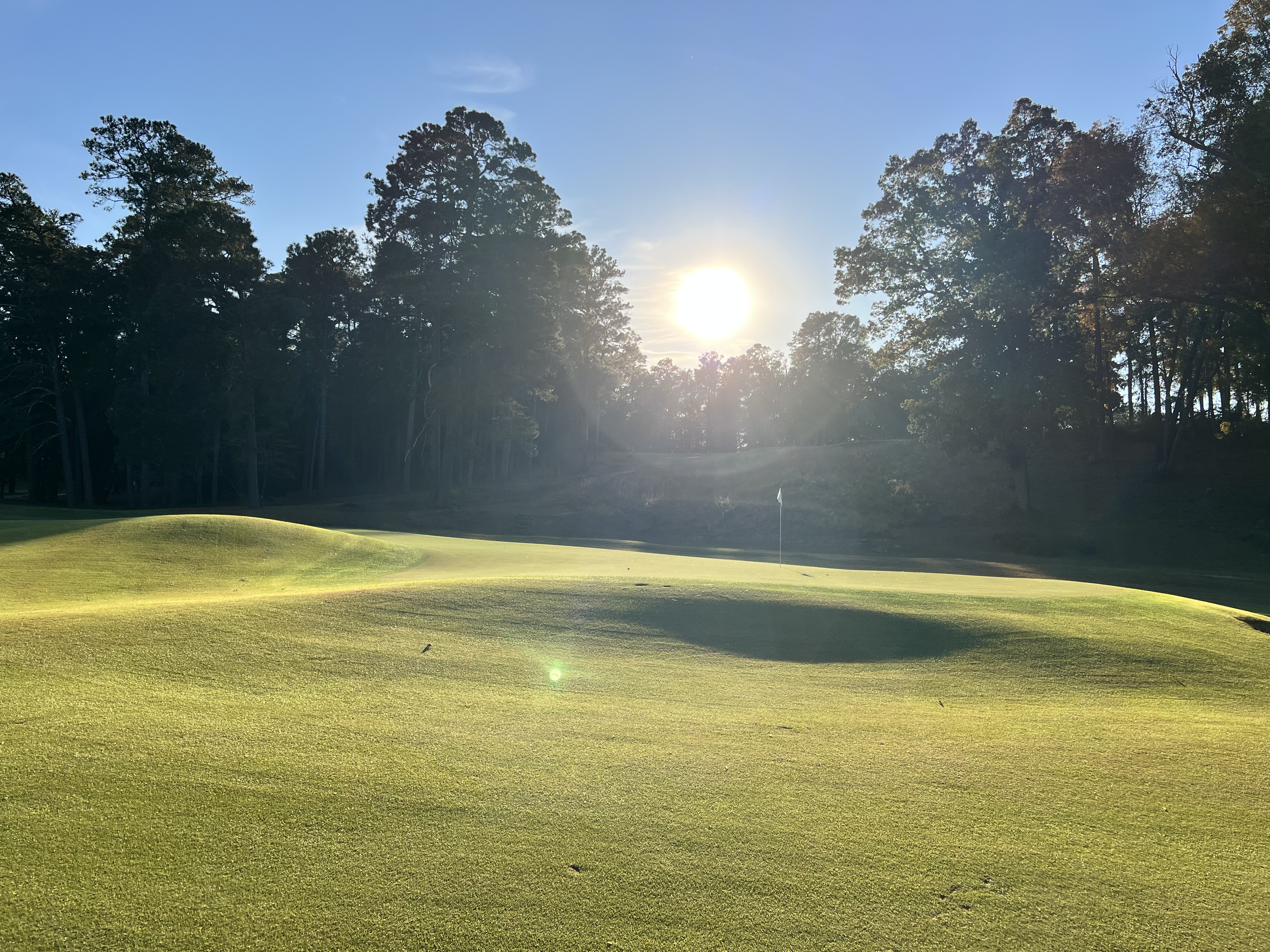
The Second is a 393 yard par 4. The stone wall runs from the tees to the right side of the fairway and must be carried from the furthest two sets of tees. Its visual may make the golfer think he needs to hedge to one side or the other but it’s a rather straight hole so try not to fall for the wall’s charming yet deceptive devices. The fairways leads to the at grade green, which has some large broad shouldered rumples about it. There are no bunkers. This is a prime example of taking the Ferrari for a test run in terms of how the golfer wants to take on the approach. A low running shot will work out splendidly so long as the distance and ground contours are all accounted for. In fact, most lower flighted shots will fare better than those high majestic ones. One could say the hole encourages the ground game. I’m first in line.


The Third is a 454 yard par 4. A forced carry off the tee to a fairway with a slight tinge of left to right movement. Bunkers are on the high left side to temper those who want to take advantage of the hillside a little too much off the tee. The green is raised from the fairway with the fairway feeding up to it on the left side. Bunkers are carved into the hillside on the right. The approach in will likely be a longer shot and the left entry point helps in figuring out a landing area. Keep in mind there is a bunker at the rear side that will collect overly ambitious approaches.


The Fourth is a 205 yard par 3. A longer par 3 to a deep green with a couple swales where again, I refused to believe the caddie’s suggested distance, which was a lot shorter than the stated yardage. So I hit something longer and yes, landed near the pin, then watched as the law of physics were once again upended and the ball raced uphill to the back of the green. It was then that I realized I was playing this course all wrong. First, my caddie knows what he’s talking about and I’m a fool. Second, it was time to change my perspective and start visualizing the ball rolling on an infinite scale. For this hole, that means either hitting something short and watch as it rolled and eventually died near the hole or hell, why not hit something to roll past the hole on the left side and use the rear bank to have it roll back towards the hole. Or for those that could pull it off, a heavy draw that lands short and right of the pin, then releases to the left side and watch as it rolls back to the hole. It was kind of like when Neo was able to start controlling the Matrix and saw everything differently. Except the exact opposite from that because while I may have started to see things differently, controlling anything was a separate matter entirely. But with this newfound vision, it was going to be a lot of fun regardless of how it turned out.


The Fifth is a 370 yard par 4. A dog leg left where the firm and fast decidedly comes into the decision making. Does one settle on something short off the tee that will roll close to the bunker straight ahead, which leaves a long blind approach. Or does one begin to calculate how much of the turn to take off by going left off the tee, the ball coming off the left side after the turn will roll to the right and leave a shorter club in. There’s a sole bunker at the rear but otherwise the field is open to the green with the mound and hills working in one direction or the other, which the golfer must learn in order to fully utilize.


The Sixth is a 178 yard par 3. The green has more subtlety here than most elsewhere, with the front section moving back towards the tee and the right edge moving down to the bunker on that side. The rear right of the green connects with the Eighth green, providing even more room for roll out. One of the few places where a high flighted ball might just stay relatively close to where it lands, there’s plenty of room within which to work if one wants to use the stretch of ground anyways.


The Seventh is a 342 yard par 4. The wider fairway is broken into two with a couple center line bunkers, forcing the golfer to decide between right and left. The left is a little narrower but leaves a better line into the green while the right is wider but leaves a more harrowing approach that must carry a scary looking greenside bunker that spans the entire right side. The green is set on a hillside while the surrounding bunkers rise up around it to create a type of barrier around it, which in general means the approach must be fairly precise even with the larger green. With things on the shorter side and considering the roll the golfer gets if the tee shot gets past the center bunkers, the shorter clubs into the green help with the precision needs.


The Eighth is a 404 yard par 4. We turn around and head back in the direction of the clubhouse, uphill. A bunker on the right pinches the otherwise wide fairway so favoring left center is a comfortable line off the tee. The fairway eventually ends, yielding to a bisecting cart path, but isn’t really in play unless the second shot is a poor one. The approach should easily carry that bisection and continue on uphill to a right to left moving deep green. The tail end of this front nine is starting to turn the screws a bit, just firming up to assert it is indeed not to be trifled with too much.


The Ninth is a 510 yard par 5. The clubhouse is now in sight as we continue uphill towards it. The bunkers define the fairway well and it seems as if right center is a good line this time. The second shot starts to turn left but mind the bunkers on either side as well as the rock outcropping on the left. The approach is to a deep, narrow green. The final climb uphill turns right just before it. There is a randomness to the off fairway and green areas where fate determines the allowable degree of recovery, which is needed here since the turns and climbs the hole takes means there are more opportunities for the golfer to veer off road. It caps off a tougher closing stretch.


The front nine starts off as an introduction to the character of the course and how such character explores the finer points on structure of play. It then begins to refine its challenge as the holes begin to run out, certain that the golfer has grown accustomed to a style of play and is able to navigate the character of the course amidst the increased difficulty. Throughout, however, the holes emphasize the roll of the ball in a modern context rarely seen done so well in such structure. I would rank them 1, 6, 4, 2, 3, 5, 7, 8, 9.
The back nine starts with the 465 yard par 4 Tenth. A longer par 4 to start off with a forced carry over a ravine off the tee. The length of the hole is tempered by its downhill to the green, so those well executed tee shots will run like there’s no tomorrow. A bunker on the right imposes itself almost all the way out to center but should only come into play for those out of position. After the bunker, the green and area around it is one of the many playgrounds among the course where the ground game is at its best. The green is at grade slightly pushed up and with no hazards save for a bunker at the rear left, the undulations are all the golfer must negotiate and he sees fit.


The Eleventh is a 133 yard par 3. The configuration reminded of the Twelfth at Jericho National in that we tee off from one hilltop to another and the right side of the hill with the green is all bunkers but here, the green is more deep set behind the bunkers and the left side is more of a strategic sliding scale. A similar topography was used for a par 3 but the changes are a subset of how things in course design had changed even in the last half decade. Here, there are more options, more variety with pin placement and that left side can be used creatively. The bunker short left off the tee reminded me of what Coore and Crenshaw did at Hidden Creek. While I’m sure it’s ties to aesthetics, it takes double duty of possibly getting into the heads of golfers, wondering why it’s there and if anyone has ever been in it just before pull toping their tee shot into it.


The Twelfth is a 543 yard par 5. A pond is behind the tee and a nice place for reflection before belting it down the wider fairway with either the surface of a rock or an upside down bunker appearing in the center of the fairway yet small enough not to divert aiming lines. The fairway arches to the right, the width continuing save for another smaller center line bunker further up. A group of bunkers on the left signifies a narrowing of the fairway closer to the green, which is relatively free of hazards except for one at the rear right. The right to left movement of the green is much quicker than it looks but yet another divine putting surface.


The Thirteenth is a 348 yard par 4. A shorter par 4 with a forced carry over long native grass to the fairway that then moves a bit uphill before turning left then downhill towards the green that is at the far left corner while a slew of bunkers line both sides. Figuring out where one would like the tee shot to end up for the approach is the first big decision here, followed by how to get the ball close to the pin, the possibilities of which include by land or by air.


The Fourteenth is a 437 yard par 4. Another forced carry tee shot over native to the fairway that widens out of view to the right while a group of bunkers on the left are very much in view. The point is there’s more room off the tee to the right than it looks. The green ended up being one of my favorites of the course. It is raised from the fairway with a large bunker below and to the right but the sides of it are ramped up as is the rear. There’s so many ways these ramped up contours can be used, which of course all depends on the approach angle. It’s a sneaky tough hole but with the some very engaging and fun components.


The Fifteenth is a 201 yard par 3. Like the Fourth, the tee shot is raised and there’s lots of land to use. Well acquainted by now with the course, I opted for a club less than the stated distance, aimed at the bunkers on the right and intended for a lower draw that would hit and advance forward and left to the pin, naturally just going in the hole if the mold hit right. It ended up a bit short but was the right idea in general. The green does run from back to front and right to left and like the Fourth, the golfer can use the roll of the ball either direction; low and running forward or as something moving back into the green. Give me a bucket of balls and a few different pin positions and come back in a week.


The Sixteenth is a 523 yard par 5. We turn around and now head back in the direction of the clubhouse. Water is all along the left side while trees are loosely about the right. The fairway also tilts towards the water, so there’s a strong suggestion for the right side off the tee. The second shot becomes precarious with a narrow fairway ahead and still with the water but those that pull off the first two shots well are aptly rewarded with a nice wide open green complex with a center bunker in front and left side bunker that actually helps keep ball out of the water. Essentially, stay right here until you pick your ball out of the hole.


The Seventeenth is a 178 yard par 3. The water isn’t done with us yet as the bulk of the the shot must carry it with a little leeway off to the short right of the green. A ridge runs across the green diagonally, which does a good job separating it into two halfs that insert a good amount of skill in coaxing the ball from one half over the ridge to the other all while trying to get it close to the hole.


The Eighteenth is a 435 yard par 4. The home hole is uphill, with the tee shot to a nice wide fairway interspersed with bunkers. One final center line bunker must be carried to the green which is likewise nice and wide yet very capable of keeping you a bit longer by sending the ball off its front and back down the hill. Make sure the approach is a healthy one into the heart of the green and you’ll be fine. One last romp on the greens and before you know it, you’re back on the wooden porches of the clubhouse, devising how to go about it next time.


The back nine continues the concepts established on the front while staying well balanced between challenge and fun. It three par 3’s make the overall a par 71 but is an example of the architects going with the best holes fitting in the terrain, despite the earthmoving and shaping otherwise. Showing nice variety, I would rank them 14, 10, 13, 15, 12, 18, 16, 11, 17.
Generally, Shelter Harbor is a well done modern course that incorporates strategic elements while showcasing a very capable playing structure to handle the highly sought after firm and fast conditions. Here, those conditions make sense and play wonderfully. In turn, the course is a prime example of the promising directions modern design can take the game if done the right way. The place in time in which the course was designed also signified more of a departure from the standard popular modern template of the late 1900’s of beauty, conditioning and difficulty, instead transitioning by keeping the conditioning and beauty aspects yet interest and strategy are emphasized over sheer penal difficulty. Recovery elements are now varied and incorporated into the design instead of do or die scenarios. In short, this transition began to ground in tenets of the classic era as the industry began to overcorrect the trends of yesteryear. Shelter Harbor shows how appealing that transition is and in some ways, is a harbinger of things to come even at present. Panther National recently opened down in Florida, rumored to be Jack Nicklaus’ final design and consists of a playing structure accommodating firm and fast conditions in a maximalist style, using such speed both for challenge and accessibility for higher handicaps. Indeed, some renovations of classic courses includes an attempt of accomplishing what Shelter Harbor has done; ensure the playing structure can handle and flourish in the conditions demanded upon it. This is decidedly a course I would not grow tired of playing, instead quite the opposite. I look forward to the next round here and the round after that, after both of which I will relax on that rear porch for a spell, bourbon slushie in hand.
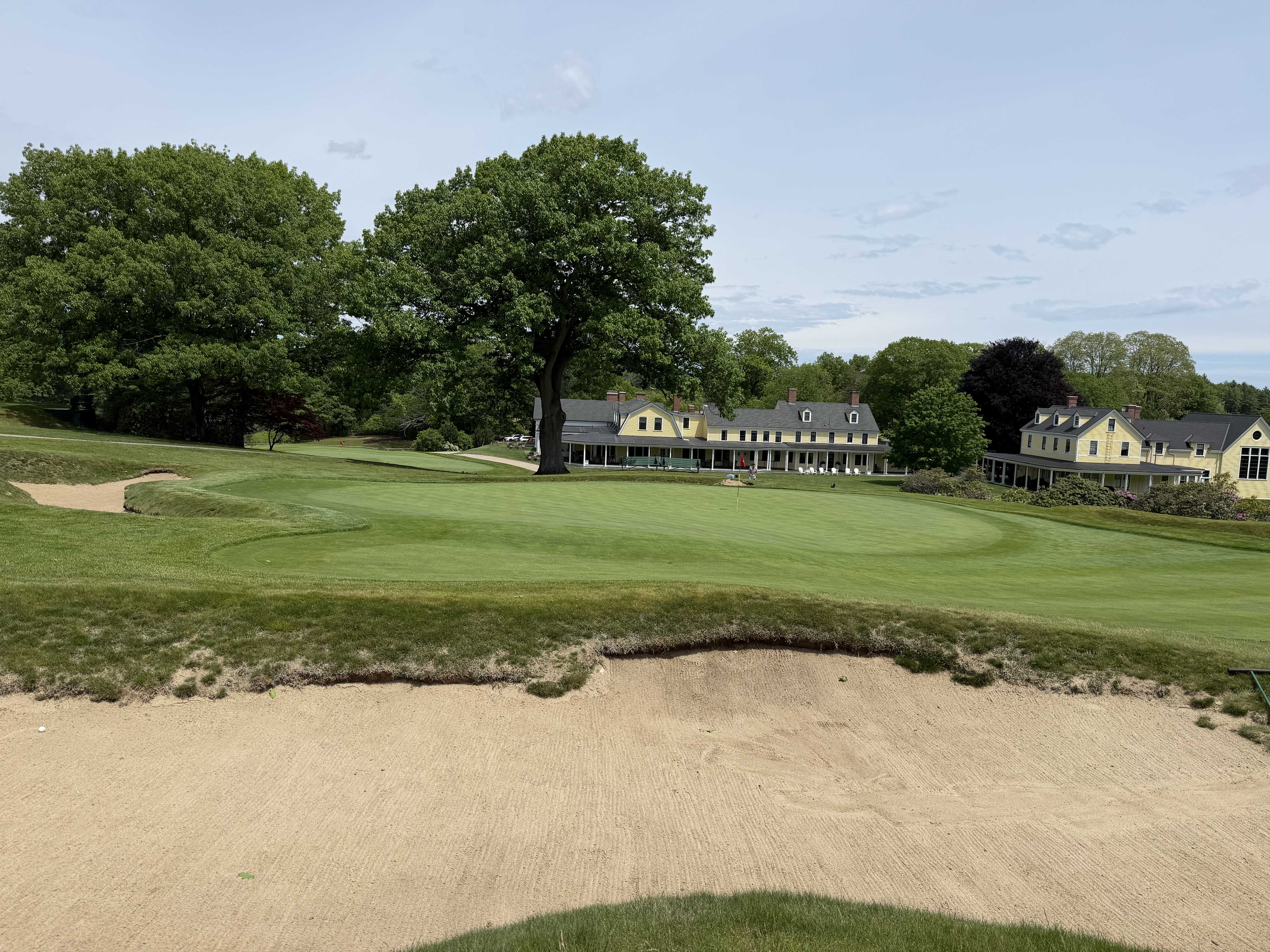
Clubhouse/Pro Shop: A gorgeous wooden shingle structure fitting within its coastal setting, dark wood shingles are contrasted with the soothing whites of the exterior columns and interior paneling. And I’m in love with that back porch.


Practice area: There is a par 3 course here as well that is highly regarded, I will need to play it next time. There’s a separate learning facility, full range, short game area and putting green.



You must be logged in to post a comment.