6,837 yards, 135 slope from the Blues
I didn’t have to go far. In exploring the eighty years of golf course design after the Golden Age and currently focusing on the couple decades just after it, I didn’t have to go far to run into an example of one era announcing itself and the other continuing its fade, blending into one course with a unified identity. I had the benefit of seeing the pros play it on television a few weeks before and they had nothing but complimentary things to say. Indeed, the course played much differently than a lot of the venues they encounter week in and week out. It was refreshing to see how bouncy and fast the course played, forcing the professionals to think about the roll and shape their shots this way and that. As I watched on television, the course did not look contrived or fraught with trees that forced these plays; instead it looked fairly open and hilly. All of this was unfolding about half hour from my television, so then and there I decided I needed to see it for myself.
Of course, I was aware of Wilmington Country Club before watching the 2022 BMW Championship. I knew it had two courses, both of which were supposed to be very good. The North was designed by Dick Wilson and opened in 1960 while the South was designed by RTJ and opened in 1959. Two of the most prominent course architects since the Golden Age with designs on relatively similar property and of notable interest, I certainly intended to play these courses at some point. Yet as I watched the BMW, I realized how urgent that visit was.
Wilmington CC started as the Delaware Field Club, a nine hole club that quickly extended to eighteen holes that was located in Elsmer, DE. It hosted the 1913 U.S. Women’s Amateur. The club’s growth led to a purchase of new land in the 1950’s, its current location. The land was enough for two courses and they opened about the same time, with the South in 1959 by RTJ and the North by Dick Wilson in 1960. The courses gained popularity and acclaim quickly, with the South hosting the 1965 U.S. Junior Amateur, then the 1971 U.S. Amateur, 1978 U.S. Junior Amateur, 1978 U.S. Girls’ Junior Amateur and 2003 U.S. Mid-Amateur before most recently hosting the 2022 BMW Championship. The RTJ design remained for decades until Keith Foster did some renovation work in 2008. While the course was considering some refresh work in approximately 2020, a tornado roared through, which razed about 300 trees and destroyed every bunker on both courses. The club retained Andrew Green to handle the repairs, yet used the opportunity to impart some renovation work as well.
Green began his project with the South in a much different condition than it had been through the the majority of its life. This allowed him a unique opportunity to revitalize character and strategy yet in new ways. This included adding shifting the Fifth fairway to the left and adding bunkers between the Fifth and Sixteenth holes, where a couple trees previously guarded the left side of the Fifth. Green also moved the Fourteenth green 60 yards further back when a 280-year-old White Oak behind the original green fell victim to the tornado. Green’s changes ultimately added 200 yards of length and found new ways of preserving RTJ’s design style of challenge, which consists of well placed bunkers around the tee landing areas, bunkers that flash so the golfer notices them well in advance and large greens with various quadrants of movement with a bevy of pin positions.
The South is on dramatically hilly property that encounters a creek or pond every now and then. The scalloped and scooped style of bunkering is prevalent throughout, adding depth to a number of those shots which vary in their degree of hazard. The land is used for variety of challenge and there’s an interesting contrast between managing firm and fast amidst rough in certain areas. Yet the hills and natural landscape is indeed incorporated into the design, creating a challenging set of visuals and angles into greens that require just as much study as the rest. Notably, the challenge is sufficient for professionals yet remains accessible to the rest of us, never holding itself as a world beater. Indeed, throughout the course of its hosting career, the South has seen many more amateur tournaments than professional. Finally and to be sure, it’s a multi dimensional course that presents many sporty situations to the golfer throughout the round.
Wilmington South is an example of an early modern course that has some of those timeless design traits more prevalent in the Golden Age, yet sought to advance its challenge components in a more direct, heroic style RTJ became historically well known for. While the Dyes focused on individuality amidst their presentation of tournament worthy challenge, RTJ leaned more towards the polished grandiose with a more traditional bunkering style that focused on variety of shot value without so much worry about asserting originality of character. This is not to say the South or other courses of RTJ do not have character; what it means is RTJ was much more comfortable working within a traditional design structure, where he would then have its original character excel in the skill values and heroism within each shot encountered . And that’s what we have at Wilmington South. A serene classic parkland presentation with a really cool and challenging playing structure that has the capacity to excite, flummox, intimidate and improve the golfer, all in the same round. For an RTJ course that highlights his potential and abilities as a course architect, look no further than Wilmington South.
Dealing with a leg injury for the months leading up to this round, I ended up pulling my calf during a race a couple weeks before and in stubborn irrationality, kept running, which absolutely made it ten times worse. I couldn’t walk for a week after the race, then it was slow going from there. I was determined to make this round happened and figured out that so long as I was careful walking up the hills, I’d be fine. Like any insane golfer, the injury didn’t really affect my golf swing so not really a big deal. With one of those cold, crisp, clear late fall mornings gracing us one or two more times before winter interjected, the rising sun watched with amusement as I set off the First tee in a strident march that was broken up every now and then with secret limps when no one else was looking.
The First is a 428 yard par 4 (from the Blues). Just to the left of the driving range, we head uphill with a first of many tee shots that require a measure of perfection from the get go. Bunkers are on either side at the landing area as are trees. The raised green and uphill nature of the hole means the approach will likely be long. The fairway leads right to the green and the green is large, so there is room to play with on the approach, yet mind the bunkers at both front right and rear left (the front of the green rotates to the left a bit, which moves the right side towards the front and left towards the rear). Green to tee, the First gets right to business yet the green allows some introductory niceties to get acquainted with the surroundings.


The Second is a 403 yard par 4. The hill upon which this tee is located is a converging point for several greens and tees while it should also be noted the green to tee walk from hole to hole are all relatively short, to the delight of the walking (or limping) golfer. The dog leg left was tough to decipher from the tee, even as the caddie tried to walk me through it. Essentially, the bunkers in view from the tee are the left side of the fairway so you can skirt by the on the right, but there is limited room since the fairway bumps downhill and it’s possible the tee shot will roll into the right rough and even behind a tree on that side, blocking a clear approach. A right to left ball flight helps tremendously here while even a left to right over the bunkers and swings back could help. The bunkers in view almost have to be aimed at. I lined up incorrectly and hit a belting tee shot but the silence from the caddie made me think the ball went to some unsavory place. It did, as I went straight, which is essentially the right side of the hole, blocked out by the trees on my approach. The green is pushed up with a narrow opening at front and bunkers on both sides more near the front. One needs to do well on the tee shot to have a clear approach, then figure out if there is an ideal position over another, which is determined based on the day’s pin position.


The Third is a 585 yard par 5. We start to get more into the hills and the tee shot is blind as the fairway climbs, then crests out of view. After the crest, it soars downhill with a cant to the right so those with the well hit tee shot will realize a nice gain of distance from the roll. All other will beed to contend with the hill contours, trees and rough, trying to get to the bottom of the hill where the water is. The water sits between the fairway and green, which needs to be carried. The golfer must figure out how he would like to carry it. The green is large and a bit more subtle than what we’ve seen thus far, inching towards the water. The golfer starts to figure out there is room for forgiveness but only so much before the course suddenly turns on him, urging him to get his act together or else. This lesson is no more apparent than at the Third.


The Fourth is a 151 yard par 3. A slightly uphill tee shot with water mostly on the left then encroaches on the center enough that most tee shot will need to carry it unless it’s a right to left flight. A bunker before the green interrupts the runs of the apron on to the green, so the golfer must maneuver around or over it if their tee shot bails out short right. To wit, there’s a bunker off to the right of the green further up, for those shots that decided to wildly steer away from the water. The green moves towards the water as well, so the hole really wants you to flirt with the hazards and pull off the heroism in avoiding them to reach safety on the green. It’s like the best reprieve we get for a while.


The Fifth is a 415 yard par 4. The tee shot is on a hillside, moving back towards the holes prior. Driver may be too much, as the hill moves downhill towards water. There’s also a strong tilt towards the right of the fairway so left to left center off the tee is a nice line. The green is on the other side of the water and to the left of the fairway, uphill. Water remains on its front side and yes, the green moves swiftly towards it. A couple bunkers are on the far right side for those too aggressive with their carry over the water and based on the movement of the green, the approach from as left as possible will do well. A devious little par 4.


The Sixth is a 368 yard par 4. Moving stiffly uphill, the fairway here is on the narrow side yet there’s nothing else to contend with off the tee. The green is off to the right of the fairway, out of view based on the hill. It’s a strong hill and the golfer will likely hit his approach up it without seeing it land. The green moves back to front and to the left a bit. Yes, there is a bunker at the front, making sure it is carried to reach the green for the golfer deciding on that line.


The Seventh is a 179 yard par 3. With the convergence of the holes in a few locations and the short transitions from green to tee, the golfer has the freedom to create his own routing as he sees fit, extending his round or shortening it, at his leisure. For the golfer that would like to remain on track, the next is a par 3, slightly downhill with three healthy bunkers lined up across the green, which has to be one of the wider of the round. Wide, yet not as deep as one wishes, so mind the downhill and have enough on it to carry the bunkers. The golfer on one side of the green need to putt to the other will have quite the task.

The Eighth is a 460 yard par 4. A dog leg right moving uphill, the bunkers are at the turn and complicate the tee shot. The tee shot manages the turn and is successful in finding the fairway once the hole straightens out, which leaves a clean approach. The green has two bunkers pinching at the front and one in the rear, which do a good job of appearing to surround it. The approach will likely be on the longer side based on the uphill, so plan accordingly since the ball will roll upon landing.


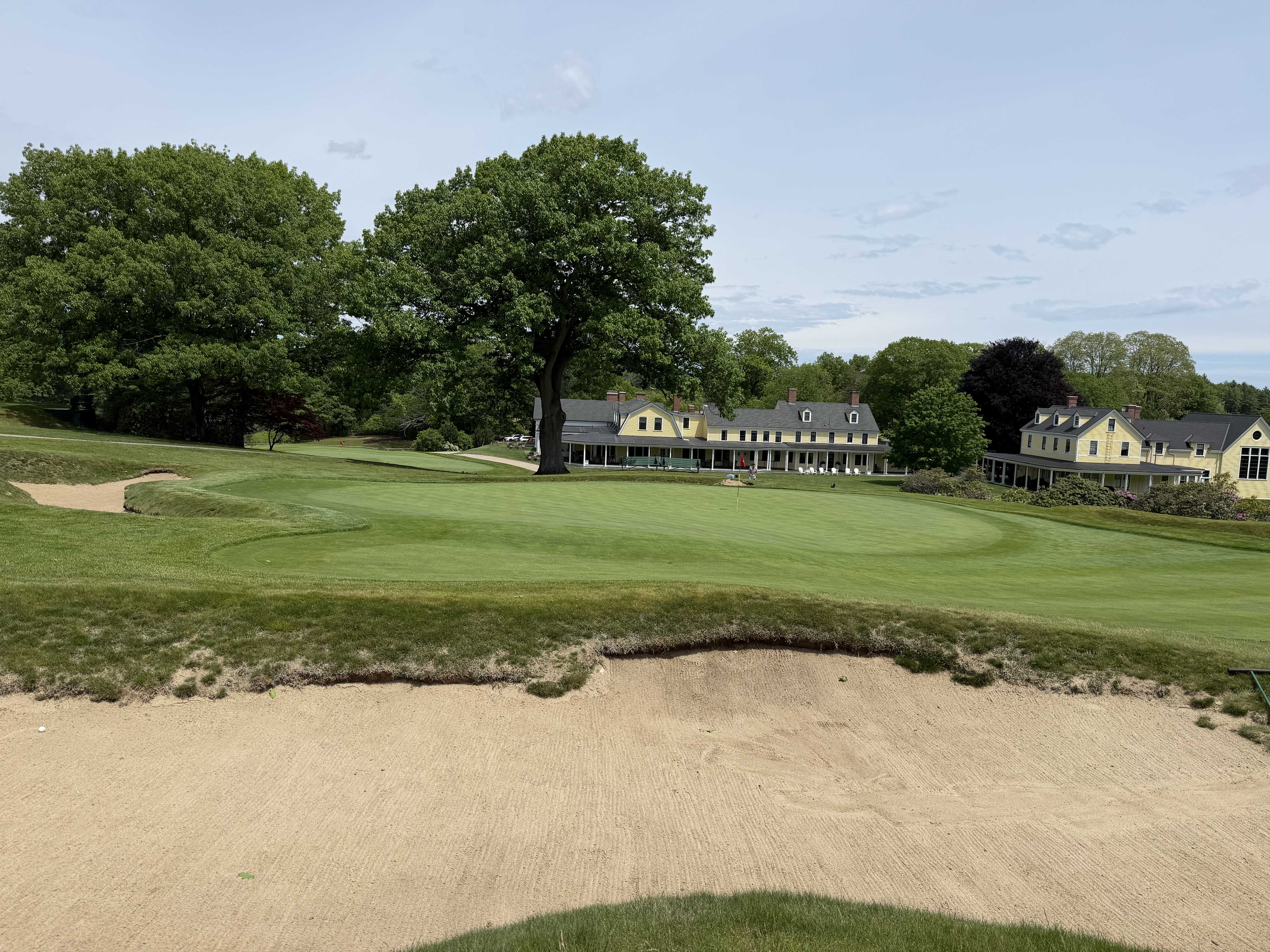
The Ninth is a 430 yard par 4. The clubhouse comes into view from the tee and the entirety of the hole is before us. Bunkers on either side of the fairway near the tee landing area ensure a more exacting effort and for the long hitters, there’s a downhill within reach that will move the ball even closer to the green. Water is off to the right and will collect those shots way off to that side. The green is uphill. For many, the approach will carry the valley altogether to reach the green. The green is amenable to the longer shot, with a couple bunkers patrolling either side yet is of a larger size to accommodate most approaches.


The front nine features hills, water, sand and grass in healthy measure. The challenge is always at the forefront yet is not contrived. Instead, there are heroic options at every turn that tempt the golfer while the smarter among us may opt for the safer routes. The safer routes of course, usually mean some measure of penance. In this way, the course was sporty and within a nicely peaceful setting. I would rank them 2, 5, 3, 6, 1, 7, 8, 4, 9.
The back nine starts with the 406 yard par 4 Tenth. A dog leg right where trees closely guard the right side the tee and a bunker is at the outside of the turn. Favoring the left side off the tee is preferable to ensure a clear look at the green but the left to right movement makes approaches tough from that side. Approaches from the right can utilize the green movement to their advantage but just make sure the trees aren’t blocking you out. It’s a deep green with a deep bunker guarding each corner.


The Eleventh is a 346 yard par 4. The tee area and green of the Tenth are in one of these converging areas of several holes. We head slightly uphill with a bunker on the right encroaching fairway width on that side. The approach is uphill as well, a large green with bunkers on either side at the front that gets wider towards the rear. The hole can be considered a drivable par 4 on occasion or the golfer will otherwise need to consider whether they will end upshort of the bunker for an approach of about 100 yards, or go to the side of or past it. The green includes a ridge that runs through it, which can be used as a back board for front hole locations while protecting back pins. Thus far, the starting duo on the back have taken a more intimate scale where trees are influencing playing structure a bit more.


The Twelfth is a 376 yard par 4. We move downhill from whence we came on the hole prior. There are bunkers on either side around the tee landing area, which is where the fairway shifts to the right. The bunkers must be dealt with off the tee, unless one really lays back. And those who take on the bunkers on the right and get past them are rewarded with contours moving the ball towards the green. The green is large with a generous entry point, which provides options for those would want to use the faster conditions to their advantage. It’s a great three-hole stretch of mid range par 4’s that need finesse and some thought to play well.


The Thirteenth is a 180 yard par 3. Walking from the green to this tee, one realizes just how well placed the holes are on the terrain and with respect to one another. They are fairly close but one never realizes it and it’s never really an issue. Here, the green is narrow and deep, cradled on a hillside moving right to left and nestled between bunkers on both sides. It’s a tougher green to hit than it looks and even tougher when the ball actually lands and starts moving about. Yet it’s a great par 3 and one must account for the terrain around him to play properly.


The Fourteenth is a 555 yard par 5. I can’t remember the last time I came across triple 5’s. All we need is this at the Fifth for the quartet. We start moving uphill with an early on dog leg right, a crowd of bunkers on the inside of the turn. After the turn, the fairway straightens out and climbs even steeper uphill. Getting close to the green is where the bunkers start to influence the approaches, which seem to be positioned around the original green site. The contours move towards the bunkers, playfully, ensuring the golfer gets his shot sufficiently up the hill and on the green. Green’s changes to the hole do well to instill the same strategy and challenge found throughout the course on the short approach, which of course impacts the golfer’s second shot into the whole ordeal as well.


The Fifteenth is a 395 yard par 4. A slight dog leg left that moves downhill from the tee before climbing back to to the green. As we have grown accustomed, the inside is well defended, here by bunkers. The fairway kind of deceptively moves towards the right, so even center shot will need up some where to the right of where they land. The green is on top of the hill, enough of an entry point to attack it by ground if the mood strikes yet most approaches will be aerial, fighting the climb to reach the green. For someone who once made fun of Dick Wilson for how many dog legs he used on his courses, RTJ is following suit with favorable results.


The Sixteenth is a 558 yard par 5. Moving down off the hill and running parallel with the Fifth on the right, the tee shot bounds high above until it comes down to the downhill fairway. Yes, there are bunkers at the tee landing area on either side of the fairway but avoiding those means taking advantage of the downhill. It’s essentially all you can handle on the second shot, a soiree of bunkers awaiting towards the green. Similar to the Fourteenth, the green is uphill from the fairway and bunkers are placed around it to collect untoward shots. The green has size though, so it can handle longer shots, so long as they account for the terrain movement, which is predominantly left to right.


The Seventeenth is a 203 yard par 3. Water defends the left side and comes into play on most shots while a triangular green consists of a lower tier at the front right while higher tiers are at the back corners. The bail out is front right or right altogether but the chips from that area to the green can get death defying.


The Eighteenth is a 399 yard par 4. The final hole was the only one on the back nine that maintained its regular position in the routing at the BMW. The dog leg left turns and dives downhill, again promoting a right to left shot and hitting the fairway means benefitting from the hill taking the tee shot close to the green. It’s a decidedly stiff final tee shot but pulling it off is important for the approach, which is to an uphill green where the pin may be blind depending on the day’s position. Bunkers are on either side of it, so the approach must be true to the green that is actually only of modest, oblong size. You must stay in form to the last.


The back nine is heads into the hills a little more than the front and starts as with some finesse holes before uncorking more brawn at the middle ones before downright accuracy at the last. The variety of challenge is all there. I would rank them 18, 12, 14, 15, 10, 13, 11, 17, 16,
Generally, Wilmington South is an effective RTJ design that relies on traditional tenets while instilling his creativity in heroism and calculated bunker placement. The firm and fast movement about the hills adds thrill to the shots and the greens fit their role well, adding strategy and skill that reverberates to shots all the way back to the tee. The setting is a splendid hilly wooded parkland where tree work has tempered corridors and allowed more horizontal versatility. Of course, recovery shots are fairly straightforward and can get rather penal. You either have a shot to get back in position or will lose a shot depending on where the ball is but those with bunker acumen will do much better here than those without it. RTJ focused on how the course played above all else and here, the course plays sporty with plenty of challenge and enough strategy to remain multi-faceted. No, it won’t wow you with a memorable gigantic bunker complex or railroad ties or outlandish greens paying tribute to some template or another, but it exacts a unique measure of skill and thought from the golfer amidst a classic structure in a well laid out, tranquil setting. For those curious what RTJ’s thoughts on the game were and the role of course architecture in it, look no further.
Clubhouse/Pro Shop: It’s large but you never realize it because of how unimposing it is. It fits on the hillside and seems to flank out, allowing plenty of space. The alternative logo here is among the best in the area as well.


Practice area: The range is just outside the rear of the clubhouse, directly next to the First and Tenth tees. Putting green is in that area as well. All within steps of each other.



You must be logged in to post a comment.